
Reviewed · WALKING TOURS
(Closed) Korea’s White House Walking Tour Blue House
Power once sat behind these gates. This small-group walk offered a rare look at Cheong Wa Dae, Korea’s former presidential compound, before public access ended. I like the nine-person limit, which keeps the guide close and makes questions easy. I also like the focus on context, from presidential offices to press rooms and traditional pavilions. The main drawback is important: this experience is now closed, so the $199 price and June access window are historical details rather than a current booking option.
When it operated, the tour lasted about two and a half hours and began at Gyeongbokgung Station at 10 a.m. Guide Jungho received especially warm praise for his excellent English, clear meeting instructions, lively storytelling, and willingness to walk one participant back toward the Metro afterward. Still, you paid a premium for a site that could be explored without a guide once access opened. Its value depended on how much you wanted political background and personal explanation, not just photographs.
In This Review
- Key points about the former Blue House walk
- Why the Blue House mattered
- Starting at Gyeongbokgung Station
- Yeongbingwan and the formal welcome
- The main Blue House building
- The older presidential office site
- The presidential residence and family life
- Chimnyugak House and a quieter pause
- Sangchunjae and traditional design
- Chunchugwan, the former press center
- What the small group changed
- Was $199 a fair price?
- Who benefited most from this tour?
- Booking, cancellation, and practical timing
- Should you book the Blue House tour?
- FAQ
- Is Korea’s White House Walking Tour currently available?
- Where did the tour begin?
- What time did the tour start?
- How long did the Blue House walking tour last?
- How many people could join the tour?
- What was included in the price?
- Was hotel transportation included?
Key points about the former Blue House walk
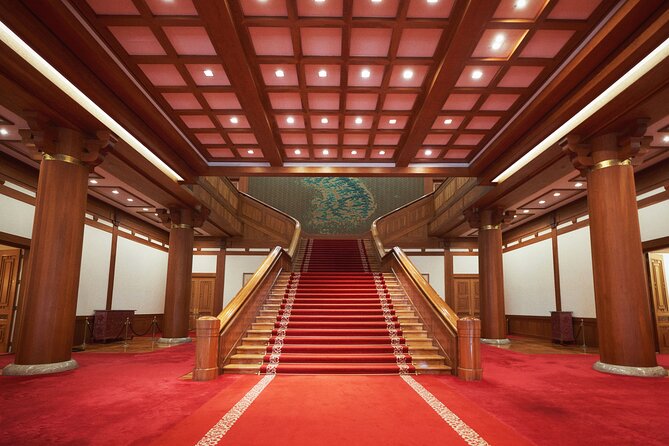
- A rare presidential setting: Cheong Wa Dae served as Korea’s presidential residence and office for more than 70 years.
- A very small group: No more than nine people joined each tour, a useful size for conversation and questions.
- Seven distinct stops: The route included reception halls, offices, a residence, traditional buildings, and the former press center.
- Jungho was a major strength: His clear English, historical explanations, and friendly personal attention helped bring the site to life.
- The tour carried a premium price: At $199 per person, it made the most sense for visitors who wanted interpretation rather than simple entry.
- The experience is closed: The advertised access period ended, so you should not plan a current Seoul visit around this tour.
Why the Blue House mattered
Cheong Wa Dae was not simply a photogenic compound with blue roof tiles. It was the center of South Korean executive power for decades. Presidents worked there, met foreign leaders, made major decisions, and lived with their families behind a carefully controlled perimeter.
For much of that period, ordinary people could not enter. Access was limited to invited dignitaries and selected public figures. Those visitors included foreign leaders, Olympic medalists, K-pop performers such as BTS, and executives from major Korean companies including Samsung and LG.
That restricted past gave the tour its main appeal. You were not just walking through another government building. You were seeing a place that had been kept apart from everyday Seoul. The change in access also gave the experience a political edge, since the opening came after a change in government and was not presented as a permanent arrangement.
That uncertainty mattered. It created urgency, but it also made the tour less predictable as a long-term sightseeing choice. If you had visited while it operated, I would have treated it as a timely opportunity, not a standard fixture like Gyeongbokgung Palace.
More Walking Tours in Seoul
- Seoul moonlight walking tour with local historian
★ 5.0 · 940 reviews - Seoul: Nighttime Hidden Gems Walking Tour
★ 5.0 · 775 reviews - Seoul: Evening Dark History, Folklore & Ghost Story Walking Tour
★ 5.0 · 593 reviews
Starting at Gyeongbokgung Station
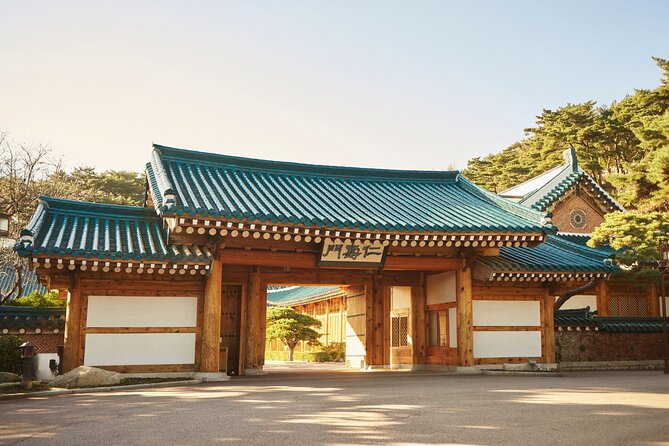
The tour began at Gyeongbokgung Station, a practical meeting point near one of Seoul’s major historic areas. No hotel pickup or drop-off was included, so you needed to reach the station on your own.
The meeting instructions were one of Jungho’s practical strengths. One participant specifically praised how clearly he explained where to meet. That matters in Seoul, where large stations can have several exits and a missed meeting can ruin a short morning tour.
The scheduled start was 10 a.m. You should allow enough time to find the correct station area and arrive early. Since the group was capped at nine, a late arrival would have had a bigger effect than it might on a large coach excursion.
The tour ended back at the meeting point. That made it easy to continue with nearby sightseeing, including the palace area or a visit to a hanok neighborhood. One person also received help getting back toward the Metro after the walk, a small but welcome sign of personal service.
Yeongbingwan and the formal welcome
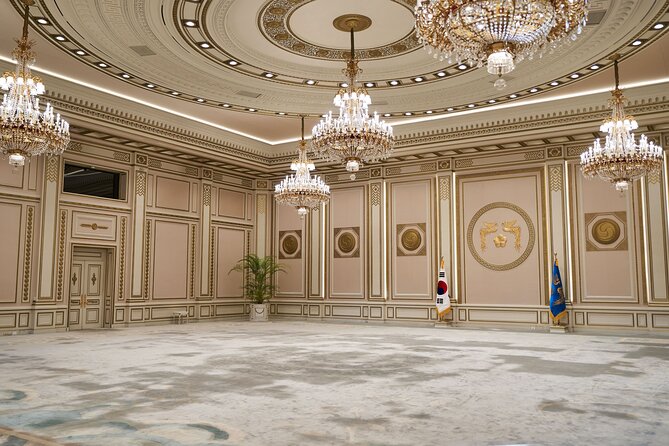
The first stop was Cheong Wa Dae Yeongbingwan, the reception building for important foreign visitors. Presidents used this setting for dinners, meetings, and other major events involving people from outside Korea.
You had about 10 minutes here. That is not enough time for a long architectural study, but it gives the guide a useful opening to explain how Korea presented itself to visiting leaders. The building combines a modern government function with Korean design elements, helping set up a theme that returns throughout the walk: official Korea often mixes modern authority with older cultural symbols.
This stop also helped you understand the Blue House as a working political site. It was not designed only for private presidential life. It had rooms and spaces intended to project ceremony, control, and national identity.
The short time here was both a benefit and a limitation. You could get the main idea without lingering too long, but anyone hoping to inspect every room or architectural detail would find the schedule brisk.
The main Blue House building
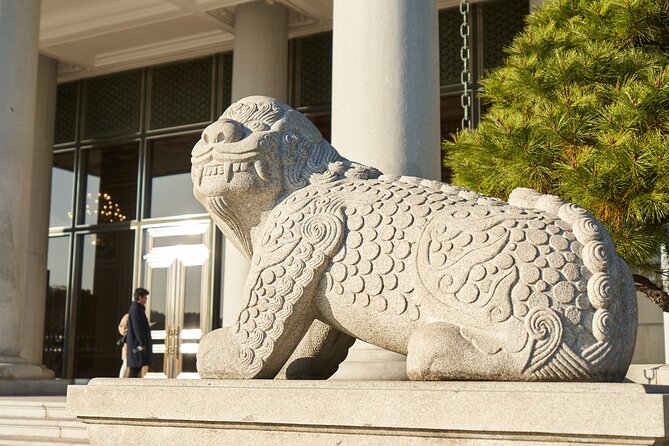
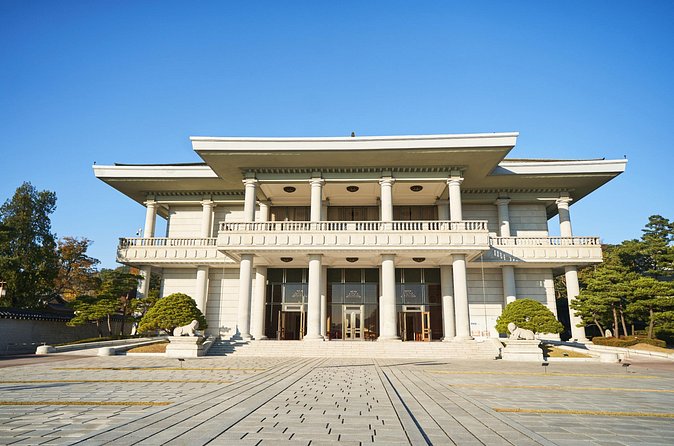
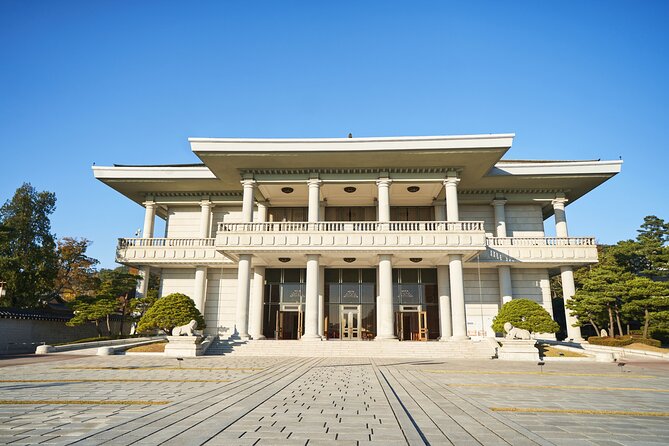
The central Blue House building was the heart of the visit. This was where the President worked and where important meetings took place. Its blue roof became one of the most recognizable symbols of the Korean government.
The scheduled stop lasted about 20 minutes. That gave Jungho room to explain the building’s purpose, appearance, and role in modern Korean government. His storytelling was repeatedly praised as a reason the site felt meaningful rather than merely scenic.
The building’s design mixes modern state architecture with Korean traditional influences. That combination is worth watching for as you walk. The Blue House was meant to look official, but it also needed to communicate Korean identity. The roof and surrounding grounds helped make the presidential compound visually distinct from ordinary government offices.
This is where a guide added the most value. Without explanation, you might see a formal building and a striking roof. With context, you could connect the structure to presidential power, public symbolism, and the long period when access was restricted.
More walking tours:
- Seoul: Dark Side of the City and Ghost Stories Walking Tour
★ 4.8 · 484 reviews - Gangnam Walking Tour on Youth and Society in Seoul Korea
★ 5.0 · 401 reviews - Seoul: Gyeongbok Palace and Bukchon Hanok Walking Tour
★ 4.8 · 157 reviews - Best Walking Tour to Gyeongbok Palace Bukchon Hanok Village
★ 5.0 · 138 reviews
The older presidential office site
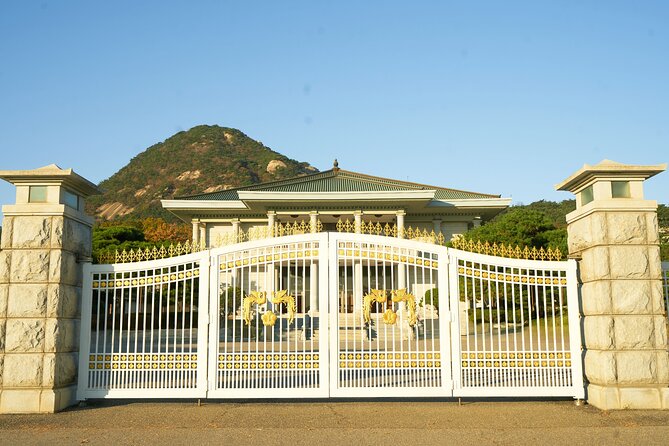
Another stop covered the area where the older main presidential office once stood, before the current Blue House building was constructed. Presidents worked here and held significant meetings, so the site connected the physical grounds to earlier stages of Korea’s modern political story.
You had about 20 minutes in this area. That was one of the longer stops, and rightly so. The location gave Jungho space to explain how the presidential workplace changed over time and how different buildings served different political needs.
This part likely appealed most to visitors who wanted more than a photo opportunity. The building itself was no longer the whole story. The ground carried meaning because of the decisions and meetings associated with it.
A possible limitation is that former office sites can feel abstract. If you expect a fully furnished room or a dramatic interior, you may find this stop less immediately exciting. Its value came from the explanation, so the quality of the guide mattered greatly.
The presidential residence and family life
The presidential residence was separate from the office. That arrangement gave the President and family a degree of privacy while keeping them within the larger compound.
The stop lasted about 10 minutes. You learned how the residence functioned as a quieter home space, surrounded by trees and set apart from official work. Bedrooms, living areas, and other domestic rooms gave the compound a more personal side.
This was a useful change of pace after the formal offices and reception spaces. Presidential sites can feel distant and ceremonial, but a residence reminds you that the people who held office also had family routines and private lives.
At the same time, you should not expect a full house tour based on the available details. The visit was brief, and the main value was understanding the separation between public duty and family privacy.
Chimnyugak House and a quieter pause
Chimnyugak House was a small traditional pavilion surrounded by trees. The group paused here while Jungho explained its architecture and history.
The 10-minute stop offered a calmer moment in the route. After the formal buildings, a compact traditional structure helped show that the compound was not made up only of offices and security-focused government spaces. Korean design traditions were part of the setting and the way important visitors experienced it.
The pavilion also gave you a natural pause during a walking tour that lasted roughly two and a half hours. The stop was short, but it helped break up the sequence of political explanations.
I would not treat Chimnyugak as the main reason to take the tour. It was one piece of a broader visit. Its appeal came from the contrast between its quiet form and the serious political work that took place elsewhere on the grounds.
Sangchunjae and traditional design
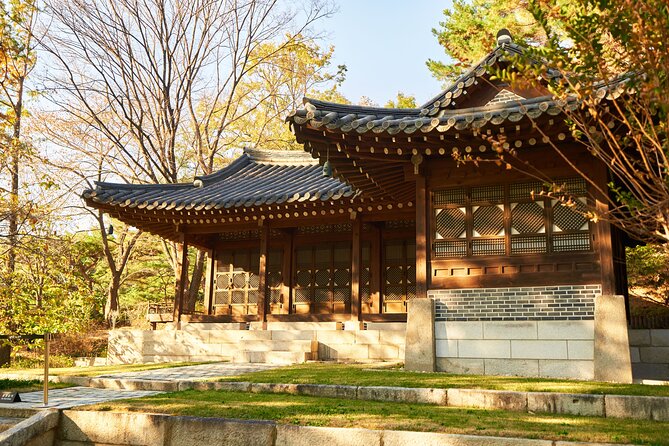
Sangchunjae was described as one of the most beautiful traditional buildings on the property. The group spent about 10 minutes walking around its wooden structure and learning how it was used for special visitors and quieter meetings.
This stop showed that traditional Korean architecture was not confined to palace museums or historic villages. It also played a role in official modern life. The building’s use for selected meetings and important guests connected cultural form with political function.
For you, this was likely one of the better photography points, although the tour’s purpose was broader than taking pictures. Jungho’s explanation helped place the building within the working compound rather than presenting it as a detached decorative feature.
The short visit meant you needed to listen while walking. If you prefer long, unhurried photo stops, the pace may have felt quick. If you prefer a structured route with a clear story, the timing kept the tour moving.
Chunchugwan, the former press center
The final listed stop was Chunchugwan, the former press center. This was where Korean and international reporters gathered for presidential announcements and official statements.
The visit lasted about five minutes, making it the briefest stop. Even so, it completed the story of how the Blue House communicated with the public. You had seen where leaders welcomed foreign officials, worked, lived, and met in traditional spaces. Chunchugwan showed the public-facing side of presidential power.
The building’s importance was less about spending time inside and more about understanding its role. Government decisions became public through press briefings and official announcements here. A short explanation could still give the place weight.
Because this was the final stop, it also gave the walk a logical ending. You moved from private and ceremonial spaces toward the point where presidential messages reached the wider country and the world.
What the small group changed
The maximum group size was nine people. That is a strong format for a site where interpretation matters more than entertainment.
In a group this small, you can usually hear the guide clearly, ask questions, and stay connected as the route moves between buildings. Jungho’s conversational style suited that format. One participant described the experience as especially memorable because of his ability to discuss history naturally and respond to questions.
The small size also made the tour feel less like a procession. You were not following a flag through a crowd or waiting for a large group to gather at every stop. That matters on a political site, where a quiet explanation can be more useful than a loud presentation.
The tradeoff was price. A nine-person tour costs more per person than a large group visit or self-guided entry. You were paying for access arrangements, a licensed English-speaking guide, and a more personal explanation of the grounds.
Was $199 a fair price?
The listed price was $199 per person. That is expensive for a two-and-a-half-hour walking experience, especially since hotel transportation, food, and personal expenses were not included.
The case for the price rested on three points. First, access to the former presidential compound was unusual and time-sensitive. Second, the group was limited to nine people. Third, a licensed guide could connect buildings and political events in a way that signs or a basic audio guide might not.
Jungho’s contribution strengthened that argument. His excellent English, clear explanations, and personal attention were repeatedly singled out as central to the experience. He also used quizzes and questions to keep the walk conversational, which suited people who wanted to think about the history rather than simply hear a list of dates.
Still, I would not call it a bargain. If your main goal was to see the blue roof and take a few photographs, $199 was hard to justify. If you had a strong interest in Korean government, recent political change, architecture, or restricted sites, the price was easier to defend.
The closure now makes the price a historical reference. You should not assume the same rate, schedule, or access arrangement exists elsewhere.
Who benefited most from this tour?
I would have recommended the experience to visitors who wanted a guided look at modern Korea, not only royal palaces and shopping streets. It suited people interested in politics, architecture, presidential history, and the way national identity appeared in official spaces.
It also worked well for first-time visitors who wanted a guide to connect separate sights. Jungho’s explanations could help you place the Blue House within the wider story of Korea, especially if you had limited background knowledge.
The tour was less suitable for anyone seeking a relaxed stroll with lots of free time. The stops were tightly timed, and some lasted only five or ten minutes. It was also not the best choice for budget-focused visitors, since the cost was high for a short walking experience.
Most travelers could participate, and service animals were allowed. The meeting point was near public transportation, but there was no hotel pickup or drop-off. Since the tour ended where it began, you needed to plan your next Seoul activity around that location.
Booking, cancellation, and practical timing
When the tour was available, confirmation arrived at booking. It was often reserved well ahead, with an average booking lead time of 38 days. That suggested access was limited and that last-minute planning could be difficult.
Free cancellation was available until 24 hours before the 10 a.m. start time. Canceling within 24 hours, or requesting changes during that period, did not qualify for a refund.
The most useful practical step was to follow the meeting instructions closely and arrive early at Gyeongbokgung Station. A small group cannot easily wait for a late arrival, and the tour’s value depended on staying with the guide from the opening explanation through the final press-center stop.
Should you book the Blue House tour?
You cannot book this experience now because it is closed. If a similar official Blue House walk returns, I would consider it worthwhile for anyone who values access and explanation over low cost.
The strongest reasons were the rare setting, nine-person group, and Jungho’s exceptional guiding. The biggest warning was the $199 price for about two and a half hours, with no transportation included.
If you are comparing a future Blue House tour with a self-guided visit, ask yourself one question: do you want to see the buildings, or do you want to understand what happened there? For the first goal, a cheaper visit may be enough. For the second, a skilled English-speaking guide could make the difference.
FAQ
Is Korea’s White House Walking Tour currently available?
No. The experience is listed as closed, so you should not plan to book this specific tour.
Where did the tour begin?
The meeting point was Gyeongbokgung Station in Seoul, South Korea.
What time did the tour start?
The scheduled start time was 10 a.m.
How long did the Blue House walking tour last?
The tour lasted approximately two hours and 30 minutes.
How many people could join the tour?
The group had a maximum of nine participants.
What was included in the price?
The price included reserved entrance to Cheong Wa Dae, also called the Blue House, and an English-speaking licensed guide.
Was hotel transportation included?
No. Hotel pickup and drop-off were not included. The tour ended back at the original meeting point.
Just added around Seoul
- Seoraksan National Park & Nami Island★ 4.5 · 3 reviews
- Strawberry Picking, Winter Sled with Eobi Ice Valley from Seoul★ 4.5 · 3 reviews
- Seoul Full Day small group Tour★ 5.0 · 3 reviews
- Majang Meat Market Experience: Private Tour with Han-woo Beef BBQ★ 5.0 · 3 reviews
- Seoul Korean BBQ Dinner Experience with Secret Food Tours★ 5.0 · 3 reviews
- Rice Wine Tasting with Sommelier – Finest Makgeolli (& Soju)★ 5.0 · 3 reviews
- Max Out Seoul: Must Visit City Highlights Panoramic Day Tour★ 5.0 · 3 reviews
- Seongsu-dong Walking Tour: K-Pop, Culture, Cheer, Friends & Relax★ 4.5 · 3 reviews
Walking Tours, compared.
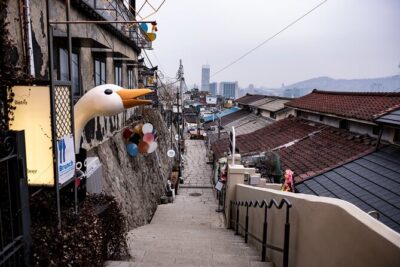
Seoul moonlight walking tour with local historian
Read our review →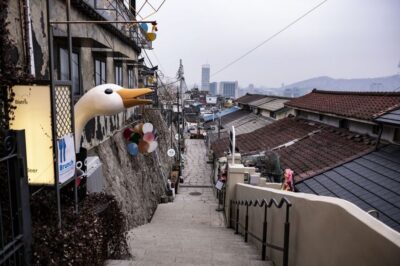
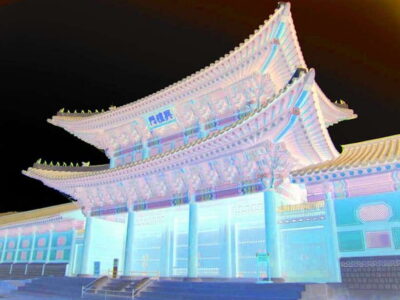
Evening Dark History, Folklore & Ghost Story Walking Tour
Read our review →Dark Side of the City and Ghost Stories Walking Tour
Read our review →
Gangnam Walking Tour on Youth and Society in Seoul Korea
Read our review →
Gyeongbok Palace and Bukchon Hanok Walking Tour
Read our review →
Best Walking Tour to Gyeongbok Palace Bukchon Hanok Village
Read our review →
Highlights & Hidden Gems With Locals: Best of Seoul Private Walking Tour
Read our review →Browse the lists this tour appears in