Reviewed · PRIVATE
Korean Green Tea Tour – from Boseong to Gangjin (Private)
Tea tastes better among green hills. This private day trip from Gwangju pairs Boseong’s famous tea fields with Gangjin’s quieter, older tea traditions. I like the mix of wide hill views and hands-on culture, especially the tea ceremony and historical rice cake tea. I also like having private transportation for a route that would be awkward to manage alone. The main drawback is the long day, with about three hours of driving spread across the route.
The experience costs about $195 per person and runs for roughly nine to ten hours. That is not a bargain basement price, but it covers private transport, admissions, a Korean tea ceremony, matcha affogato, and the Gangjin rice cake tea experience. Lunch is extra, and you choose and pay for your own meal in Boseong-eup.
In This Review
- Five things to know before you go
- Why this tea tour is different from a simple farm visit
- Daehan Dawon gives you the classic Boseong view
- Lunch in Boseong-eup keeps the meal local
- The Korea Tea Museum explains what is in your cup
- Nokcha-ro offers Boseong from a different angle
- Gangjin Dawon changes the mood
- Baegundong Hermitage Garden adds Joseon-era context
- Baegun Tea House tells a Korean tea story
- The included tastings make the price easier to justify
- Guides can turn a complicated route into an easy day
- Who should book this day trip
- Should you book the Korean Green Tea Tour?
- FAQ
- Where does the Korean Green Tea Tour start?
- How long does the tour last?
- Is this a private tour?
- Is lunch included?
- What tea experiences are included?
- Can I cancel for a full refund?
Five things to know before you go
- Three tea traditions in one day: Taste leaf tea, powdered green tea, and Gangjin’s traditional rice cake tea.
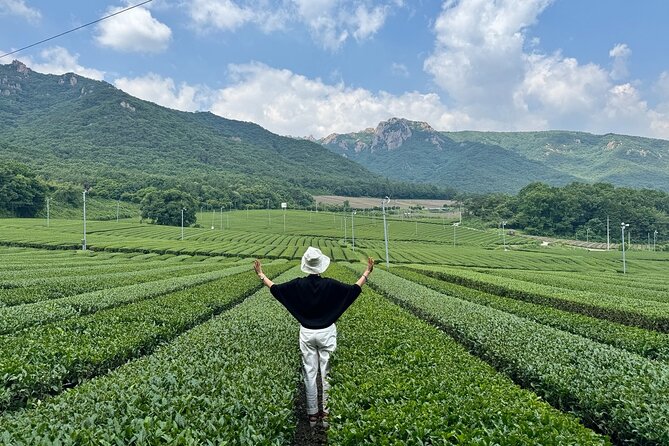
- Boseong delivers the big views: Daehan Dawon and Nokcha-ro offer rolling rows of tea plants across the hills.
- Gangjin adds the history: Baegundong Hermitage Garden and Baegun Tea House connect tea with Joseon-era culture and Korea’s first tea brand.
- Private transport saves time: The route takes about 70 minutes from Gwangju to Boseong, 50 minutes to Gangjin, and 70 minutes back.
- The guides add real value: Guides named Veronica and Vicky have been praised for clear explanations, local food suggestions, and flexible help.
- Plan for a full day: The schedule includes seven stops, a meal break, walking, tasting, and several hours in the car.
Why this tea tour is different from a simple farm visit
Boseong is the visual star. Its tea fields run in neat lines over rounded hills, giving you the classic Korean tea-country scene. Gangjin is less familiar to international visitors, but that is exactly why it earns its place on this trip. Its tea story reaches back more than 1,000 years, and the area is linked to Korea’s first tea brand.
I like the way the day moves beyond pretty scenery. You begin with the plants and the farms, then learn how tea is made and served, and finally reach places where tea connects with writers, monks, gardens, and local business. The result feels more thoughtful than a quick stop for green tea ice cream, though you still get that ice cream too.
The private format matters here. Boseong and Gangjin are separate areas, and public transport would make this route slow and complicated. With your own vehicle, you can move between the fields, museum, garden, and tea house without spending the day checking connections.
The trade-off is time. You will not spend nine or ten hours walking through tea gardens. Some stops last only 30 or 40 minutes, and the road time is significant. Still, the driving links two distinct parts of South Korea’s tea culture, which is the point of the outing.
More private tours:
- Busan Private Tour with licensed tour guide + private vehicle
★ 5.0 · 1,143 reviews - Private DMZ Tour (No Shopping): 3rd Tunnel & Suspension Bridge
★ 5.0 · 607 reviews - Jeju Island English Private & Flexible Tour any number anywhere
★ 5.0 · 561 reviews
Daehan Dawon gives you the classic Boseong view
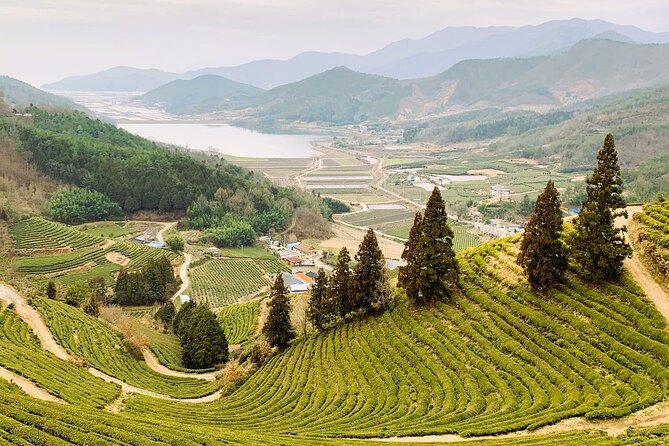
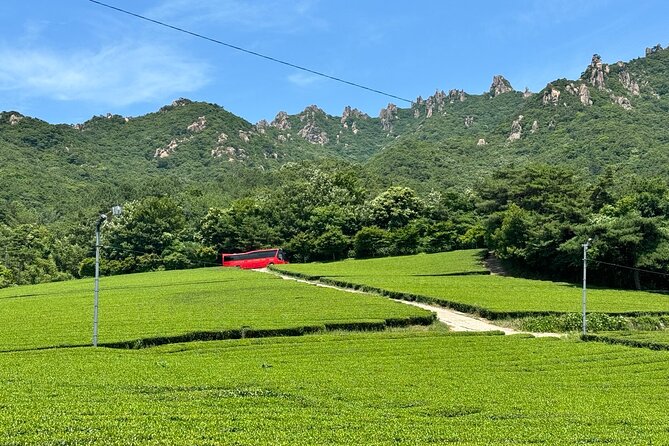
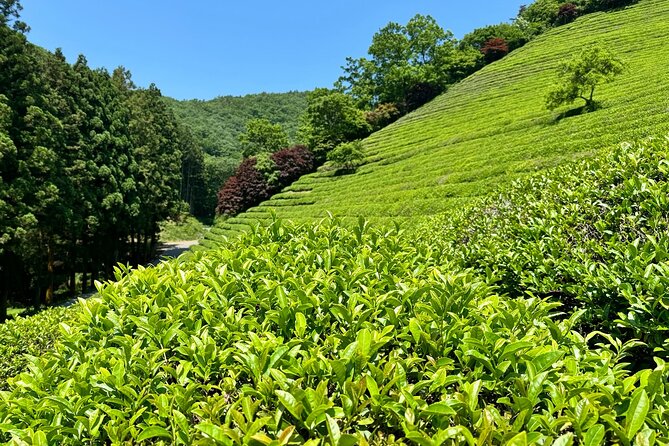
The first major stop is Boseong Green Tea Field Daehan Dawon, with about 90 minutes to explore. Boseong County has soil and weather suited to green tea, and the tea farms here are described as organic.
This is where you get the wide views that make Boseong famous. The rows of tea plants climb and curve over the hills, creating an orderly pattern that looks almost painted from a distance. You will have time to walk through the fields, take photographs, and enjoy the scale of the farm rather than simply stopping at a roadside viewpoint.
The included admission is useful because you do not need to handle separate entrance arrangements. Wear shoes suited to walking on slopes, since the fields are not a flat garden path. The tour data does not give a precise walking distance, so I would keep your pace comfortable and save some energy for the later stops.
Daehan Dawon is also the busiest-feeling part of the day in spirit, even though this is a private tour. It is the place most associated with Boseong, so it can feel like a must-see rather than a quiet discovery. If your main goal is dramatic tea-field scenery, this stop earns its time.
Lunch in Boseong-eup keeps the meal local
After the first field, you have about an hour for lunch in Boseong-eup. The meal is not included, which keeps the tour price from rising for people with different appetites or food preferences.
You can choose from local dishes such as stir-fried nakji, Korean octopus. The exact restaurant and final dish depend on the arrangements for the day, so you should treat lunch as a flexible local meal rather than a fixed tasting menu.
I see this as a useful pause. A full day of tea, walking, and driving needs a proper break, and eating in town gives you a taste of Boseong beyond its farms. Bring a payment method suitable for the restaurant, since you pay for lunch directly.
The one limitation is that the tour price does not tell you the likely cost of the meal. If you are traveling on a tight budget, ask your guide about the available choices before ordering.
The Korea Tea Museum explains what is in your cup
The Korea Tea Museum gives you about an hour indoors. This stop covers the tea plant itself, the six types of tea that can be made from it, the development of Korean tea, and the local green tea industry.
That background helps make the rest of the day easier to understand. Without it, the fields can seem like attractive rows of plants. With it, you begin to see why harvesting and processing matter, and why green tea can appear in several forms.
This is also a welcome change of pace after the open-air farm. If the weather is hot, wet, or simply tiring, an indoor museum gives you time to reset. The admission is included.
Do not expect a huge museum visit. The scheduled hour suggests a focused introduction rather than an all-day cultural institution. Its value is in giving you the basic framework for the tea ceremony and tastings that follow.
A completely different kind of day out in South Korea:
- Best DMZ Tour Korea from Seoul (Red Suspension Bridge Optional)
★ 5.0 · 41,422 reviews - DMZ Tour: 3rd Tunnel, Option(Suspension Bridge, Boat) from Seoul
★ 5.0 · 21,373 reviews - DMZ tour south Korea from Seoul (NK experience hall, defector)
★ 5.0 · 20,599 reviews - DMZ Insider Tour: 3rd Tunnel, NK Defector Meet & Red Bridge
★ 4.9 · 15,214 reviews
Nokcha-ro offers Boseong from a different angle
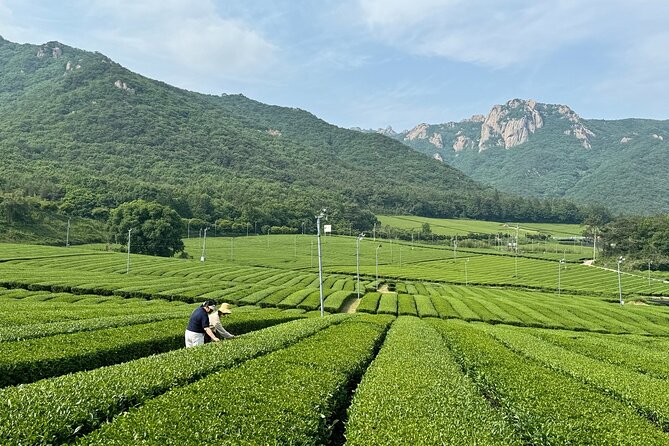
Nokcha-ro is a shorter stop, about 40 minutes, at the Choroknip tea farm operated by Boseong Jeda. Its tea house terrace is known for views across the rolling fields below.
I like the contrast with Daehan Dawon. At Daehan Dawon, you are among the rows. At Nokcha-ro, you can pause above them and take in the shape of the hills. This is a good place to slow down, enjoy the view, and take photographs without trying to cover too much ground.
The stop is listed without an admission charge. The schedule is brief, so you should not expect a long tea-house session unless the day’s timing allows it. The main attraction is the viewpoint and the chance to see another important Boseong growing area.
Gangjin Dawon changes the mood
The drive from Boseong to Gangjin takes about 50 minutes. That road time is one reason private transport is so valuable. You leave the best-known tea destination and head toward a quieter area at the foot of Mount Wolchulsan.
Gangjin Dawon has been cultivated for green tea since 1980 by Osulloc, one of Korea’s leading tea producers. Yet the local tea story is much older than that planting date. Gangjin’s tea culture reaches back more than 1,000 years, giving this stop a different character from the commercial farm scenery in Boseong.
You have about 30 minutes here, so this is a short scenic visit rather than a long farm walk. I would treat it as a bridge between the two regions. Boseong shows you the modern image of Korean tea country. Gangjin begins to explain why tea has mattered here for centuries.
The shorter stop may disappoint you if you want extensive time among the plants. On the other hand, the compact visit helps the whole day fit into a manageable schedule.
Baegundong Hermitage Garden adds Joseon-era context
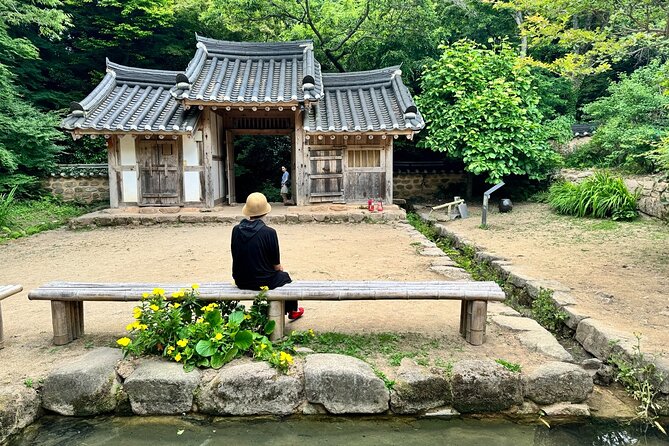
Baegundong Hermitage Garden is one of the most distinctive stops. Built in the late 17th century during the Joseon Dynasty, it was designed to work with the natural setting rather than ignore it.
You have about 40 minutes to see the garden. The site is tied to the revival of tea culture in Gangjin, so the visit is not just about ornamental planting. It gives you a sense of how tea, retreat, scholarship, and carefully shaped outdoor spaces came together in an earlier period.
This stop also keeps the day from becoming a series of commercial farm visits. The fields show production. The garden shows tea as part of a way of life and a cultivated setting.
The timing is enough for an introduction, but not for a slow, scholarly study of every feature. If gardens are your main interest, you may wish the stop were longer. Even so, it is a strong reason to choose this route instead of visiting only Boseong.
Baegun Tea House tells a Korean tea story
The final stop is in Seongjeon-myeon, at Baegun Tea House, for about 40 minutes. The tea house honors Baegun Okpan Tea, described as Korea’s first tea brand, created in the 1920s by Lee Han-young, a descendant of one of Jeong Yak-yong’s disciples.
Jeong Yak-yong, also known as Dasan, was a major scholar who spent time in exile in Gangjin. That connection gives the tea story an intellectual and personal side. Tea here is not presented only as an agricultural product. It is connected to people, place, writing, and local memory.
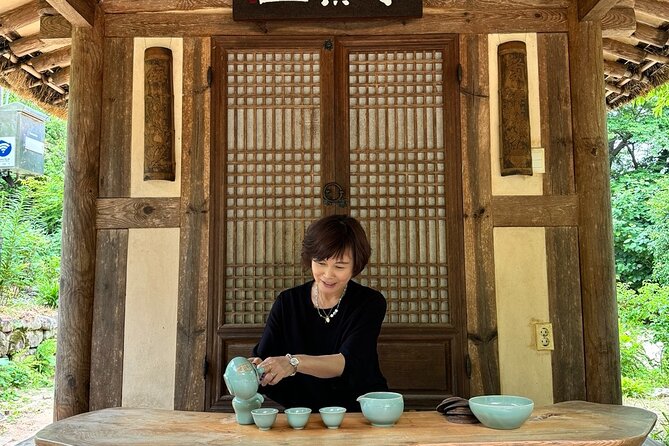
This is where you taste the historical rice cake tea, a tradition said to be 200 years old. It gives you a very different experience from a standard cup of leaf tea. The inclusion is one of the tour’s strongest features because it brings an older local practice into a modern day trip.
The stop may appeal most to people who enjoy cultural explanation as much as scenery. If you want only tea-field photographs, it may feel less immediate than Boseong. If you want to understand why Gangjin matters, it is essential.
The included tastings make the price easier to justify
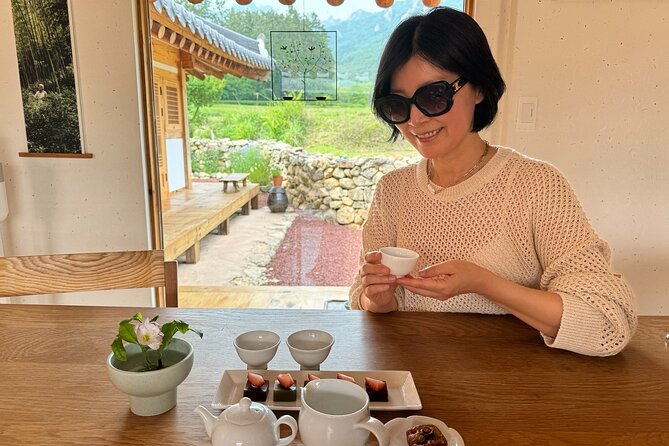
Three inclusions shape the day: matcha affogato, a Korean tea ceremony in Boseong, and historical rice cake tea in Gangjin.
The matcha affogato combines powdered green tea with green tea ice cream. It is the lightest and most playful tasting of the three. You get a familiar dessert format, but with a strong local flavor.
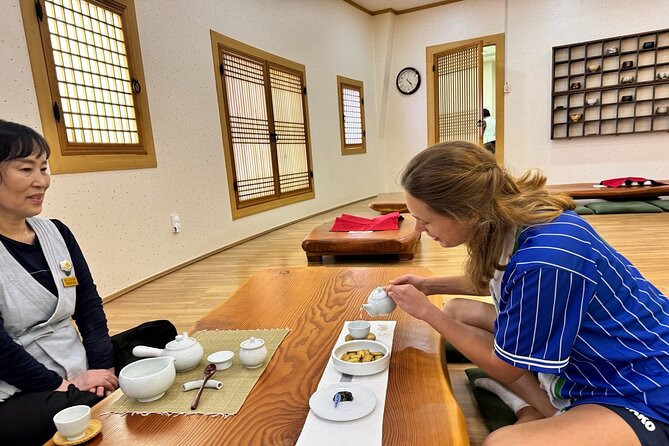
The ceremony is more instructive. You can see how Korean tea is prepared and served rather than treating tea as something you simply order in a café. Since the tour also explains the tea plant and its processing, the ceremony gives the earlier information a practical setting.
The rice cake tea is the most unusual inclusion. Its 200-year tradition gives the final tasting a sense of place that a generic green tea sample would not provide. Together, the three tastings cover powdered tea, leaf tea culture, and a distinctive Gangjin preparation.
At $195 per person, the value depends on how much you want from the day. A solo visitor may find the price high. For a private group, the cost becomes easier to defend because transportation, admissions, guiding, and the tastings are bundled together. Group discounts are available, so larger parties should check the final rate.
You still need to budget for lunch. Alcoholic drinks and travel insurance are also excluded.
Guides can turn a complicated route into an easy day
The guide is an important part of this experience. Veronica has been praised for her tea knowledge, local restaurant suggestions, and ability to adapt the day to personal interests. Vicky has also been praised for explaining tea production and tasting, as well as for her connection to Gwangju.
Those details matter because the route is not self-explanatory. At the fields, a guide can explain what you are seeing. At the museum, a guide can connect the displays to the tastings. In Gangjin, a guide can explain why a garden, tea house, and rice cake tea belong in the same story.
The private format also allows more direct conversation. Past praise for Veronica includes help with transportation problems beyond the scheduled visit, though you should not assume every extra request can be accommodated. The practical advantage is that you have one guide focused on your group rather than trying to follow a large crowd.
The tour is offered from Gwangju Metropolitan City, with a 9:30 am start. The return drive from Gangjin to Gwangju takes about 70 minutes, so expect to reach the city in the evening.
Who should book this day trip
I would recommend this tour to you if you like gardens, regional food, scenic drives, and cultural background. It is especially good for tea drinkers who want more than a café stop, and for first-time visitors to southwestern Korea who want to see beyond the major city sights.
It also suits people who value comfort. The route covers multiple areas, and private transportation removes much of the planning burden. Service animals are allowed, most people can participate, and the tour is near public transportation, though the activity itself uses private transport.
You may want to skip it if you dislike long drives or prefer a slow visit to one location. The schedule is full, and several stops are short. Someone focused only on tea shopping may also find the historical and garden visits less useful.
The experience requires good weather. If poor weather cancels the tour, you can choose another date or receive a full refund. You can cancel for a full refund up to 24 hours before the start time, but late cancellations and changes are not accepted.
Should you book the Korean Green Tea Tour?
Book it if you want the full story of Korean tea in one day: Boseong’s famous hills, Gangjin’s older traditions, a ceremony, a museum, a historic garden, and three different tea tastes.
I especially like that the route gives Gangjin equal importance rather than treating it as an afterthought. The big Boseong views may draw you in, but the Baegundong garden and Baegun Tea House give the day its character.
At $195 per person, this is best for a private group or for anyone who would struggle to reach both regions independently. If you can accept the long day and extra lunch cost, it offers a well-connected, personal look at an important part of South Korea.
FAQ
Where does the Korean Green Tea Tour start?
The tour starts from Gwangju Metropolitan City at 9:30 am.
How long does the tour last?
The experience lasts approximately nine to ten hours.
Is this a private tour?
Yes. Only your group participates in the private activity.
Is lunch included?
No. Lunch is not included. You choose a meal in Boseong-eup and pay the restaurant directly.
What tea experiences are included?
The tour includes a Korean tea ceremony in Boseong, matcha affogato made with powdered green tea and green tea ice cream, and historical rice cake tea in Gangjin.
Can I cancel for a full refund?
Yes. You can cancel at least 24 hours before the start time for a full refund. If poor weather causes the tour to be canceled, you will be offered another date or a full refund.
Just added around South Korea
- Seoraksan National Park & Nami Island★ 4.5 · 3 reviews
- East of jeju tour for Seogwipo Gangjeong Cruise Customers★ 4.5 · 3 reviews
- Strawberry Picking, Winter Sled with Eobi Ice Valley from Seoul★ 4.5 · 3 reviews
- Seoul: Seohaerang Cable Car, Gwangmyeong Cave, etc (EG Tour)★ 5.0 · 3 reviews
- Seoul: Seorak Mountain, East DMZ, and Sokcho Tour★ 5.0 · 3 reviews
- Seoul Full Day small group Tour★ 5.0 · 3 reviews
- Rice Wine Tasting with Sommelier – Finest Makgeolli (& Soju)★ 5.0 · 3 reviews
- Majang Meat Market Experience: Private Tour with Han-woo Beef BBQ★ 5.0 · 3 reviews
Private, compared.
Busan Private Tour with licensed tour guide + private vehicle
Read our review →
Private DMZ Tour (No Shopping): 3rd Tunnel & Suspension Bridge
Read our review →
Jeju Island English Private & Flexible Tour any number anywhere
Read our review →
Private Busan Tour -Explore Cultural Landmarks with a Local Guide
Read our review →
Seoul City Private Full-Day Tour Including Lunch
Read our review →
Private DMZ the 3rd Tunnel Tour from Seoul (optional Red Bridge)
Read our review →
Jeju Island Popular Sightseeing Private Car Charter Tour 5/9hours
Read our review →