
Reviewed · HANOK VILLAGE & FOLK CULTURE
Korean Folk Village & Suwon Hwaseong Fortress Private Tour
History gets hands-on here. This private Seoul outing pairs the 5.7-kilometer Hwaseong Fortress with the lively Korean Folk Village, giving you both royal-era walls and everyday Joseon life. I like the clear contrast between the two stops, and I like having a private guide and air-conditioned vehicle for the trip south.
The strongest praise goes to the guides, including Michelle, Nate, and Ben, who bring history to life with warmth and humor. The main drawback is the price, $296.50 per person, especially since lunch is not included and the fortress visit lasts only about an hour.
In This Review
- Key points to know before you book
- Two major sights, one useful day out of Seoul
- Walking the 1794 to 1796 walls of Hwaseong
- What the 245-acre Korean Folk Village adds
- Why the private guide is the main selling point
- The price: strong convenience, but not a bargain
- Who will get the most from this day
- Practical planning for a smoother visit
- Should you book the Hwaseong and Folk Village tour?
- FAQ
- How long does the private tour last?
- Where does the tour take place?
- Is pickup available?
- What is included in the price?
- Is lunch included?
- How much time is spent at Hwaseong Fortress?
- How much time is spent at the Korean Folk Village?
- Is this a private tour?
- Can I cancel for a full refund?
Key points to know before you book
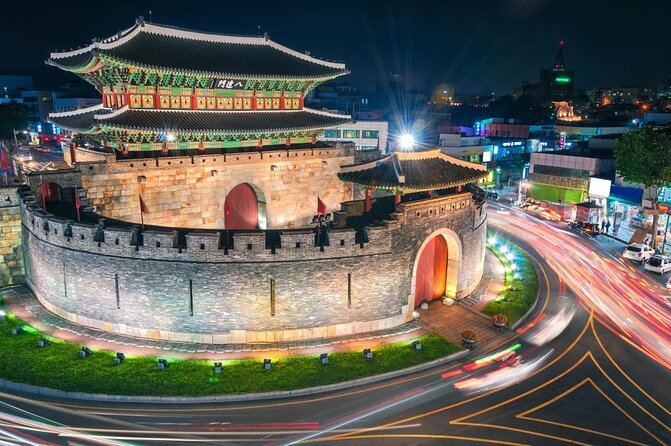
- King Jeongjo’s 5.7-kilometer fortress: Walk beside restored walls, gates, pavilions, command posts, and beacon platforms in Suwon’s historic center.
- A full Joseon-era village: The 245-acre Korean Folk Village includes relocated homes, working craftspeople, livestock, gardens, and scheduled performances.
- Private touring changes the pace: Only your group takes part, so you can ask questions and spend more time on the parts that interest you.
- Guides receive the highest praise: Michelle, Nate, and Ben are singled out for warmth, humor, and strong knowledge of Korean history.
- About six to seven hours from Seoul: Pickup, an air-conditioned vehicle, village admission, and taxes are included, but lunch is your responsibility.
- Moderate fitness helps: Hwaseong Fortress rises and falls over Paldal-san, so expect some walking on sloped ground.
Two major sights, one useful day out of Seoul
Suwon lies about 30 kilometers south of Seoul, close enough for a practical day trip but far enough to feel like a change of scene. The city is the largest in Gyeonggi-do province, and its old center is ringed by the surviving fortifications of Hwaseong.
I like this pairing because the two stops answer different questions. At the fortress, you see how the Joseon court protected and organized a city. At the folk village, you get a more physical sense of how ordinary homes, workshops, farms, and public ceremonies looked during the same broad period.
The private format matters here. Instead of joining a large group, you travel with your own party in an air-conditioned vehicle. That gives you a guide who can explain details at your level, help keep the day moving, and adjust the conversation for adults, children, or teenagers.
The day lasts roughly six to seven hours. That is long enough to make the journey worthwhile without turning the outing into an exhausting full-day march. Still, the schedule gives much more time to the folk village than the fortress, so you should book this for a broad introduction rather than an in-depth architectural study of Hwaseong.
More Private Tours in Seoul
- Private DMZ Tour (No Shopping): 3rd Tunnel & Suspension Bridge
★ 5.0 · 607 reviews - Seoul City Private Full-Day Tour Including Lunch
★ 5.0 · 469 reviews - Private DMZ the 3rd Tunnel Tour from Seoul (optional Red Bridge)
★ 5.0 · 429 reviews
Walking the 1794 to 1796 walls of Hwaseong
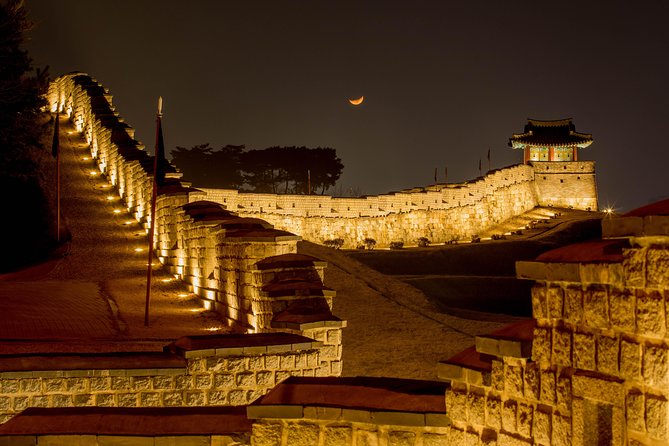
Hwaseong Fortress is the first major stop, with about one hour set aside for the visit. The wall encloses Suwon’s original town and climbs over Paldal-san, a 143-meter hill. You will not be walking a flat path the entire time. The rise and fall are part of the appeal, but they also explain the moderate fitness requirement.
King Jeongjo ordered the fortress built between 1794 and 1796. He planned to move the royal court south from Seoul, and Suwon nearly became Korea’s capital. The king died before that plan took shape, leaving Seoul as the seat of power and Suwon with one of the country’s most memorable historic sights.
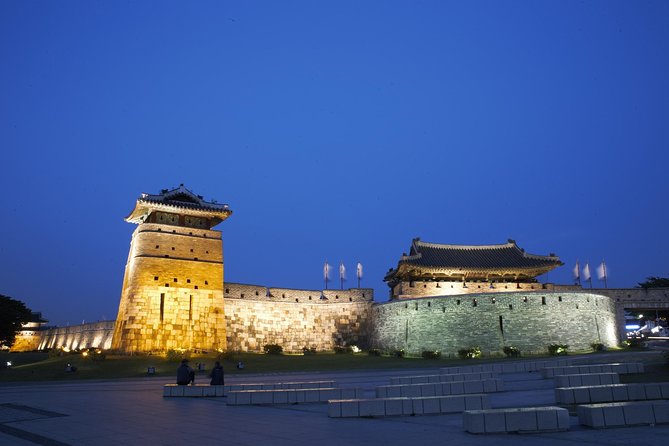
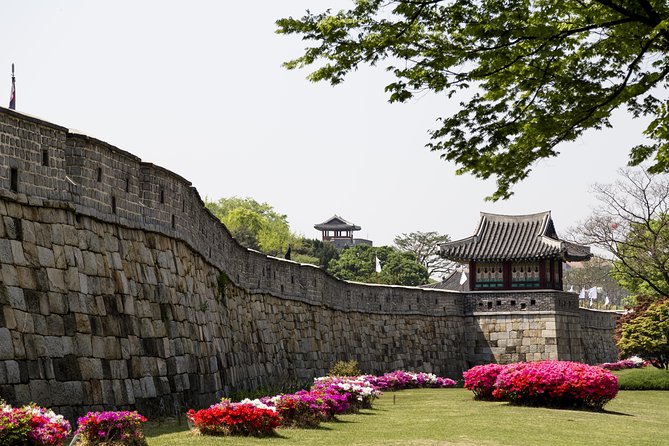
The wall stretches 5.7 kilometers and passes four large gates. Along the route are command posts, pavilions, observation towers, and fire-beacon platforms. These features make the visit more than a simple walk beside old stone. You can see how soldiers watched the approaches, sent signals, and controlled movement through the city.
The fortification was built with an earthen core faced in large stone blocks and gray bricks. Nearly all of what you see has been restored, so this is not an untouched ruin. That is worth keeping in mind if you prefer rough, original remains. On the other hand, the restored walls make the structure easy to understand, and the route gives you a strong sense of its scale.
The free admission is a small advantage, since your tour price is not being used to cover a costly fortress ticket. The bigger value comes from having a guide explain why Suwon mattered and how the wall fit into King Jeongjo’s plans. Without that context, you might simply see a pleasant hill walk with impressive masonry.
One hour is enough to see a section of the fortifications and understand their shape. It is not enough to walk the full 5.7 kilometers, so do not expect a complete circuit. If Hwaseong is your main reason for visiting Suwon, ask your guide early which gates and viewpoints you will see during the allotted time.
What the 245-acre Korean Folk Village adds
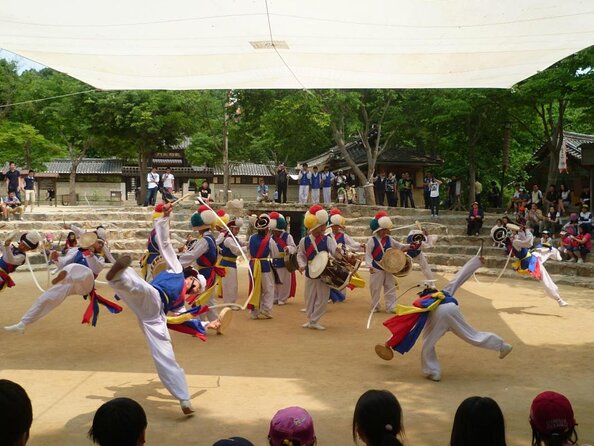
The Korean Folk Village receives about three hours, making it the heart of the day. This large outdoor site is designed to show Joseon-period life through buildings, crafts, performances, gardens, animals, and staged events.
Homes with thatched or tiled roofs have been relocated from different parts of Korea and arranged across the grounds. That gives you more than a single restored house. You can compare different building types and see how a historic settlement might have looked across regions.
The setting is theatrical, but it is not only a collection of buildings. Performers in hanbok demonstrate traditional work, including pottery making and handmaking paper. Other workers tend vegetable plots and livestock. These details help connect historic architecture with the daily labor that once took place around it.
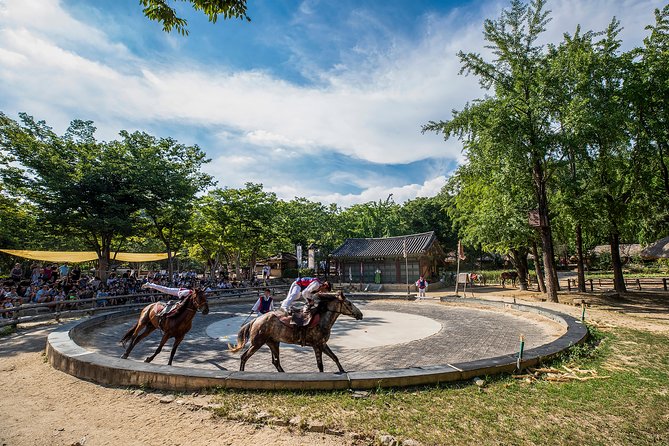
You may also see traditional musicians, dancers, acrobats, and tightrope walkers during the day. A staged wedding ceremony is another possible highlight. These performances give the visit energy and variety, especially if you are touring with children or teenagers who may not want several hours of walls and formal explanations.
I especially like the balance between watching and doing. You can study a tiled building, then see a craft demonstration, then move on to music or acrobatics. The program keeps the site from feeling like a silent open-air museum, though the staged nature means you should not mistake every performance for an ordinary village scene.
Three hours is a generous amount of time. You can see several areas without racing, pause for a performance, and ask your guide about customs or buildings. Since the grounds cover 245 acres, comfortable walking shoes are sensible. The tour information does not promise a specific performance schedule, so the exact shows you catch can depend on the day and timing.
Admission to the Korean Folk Village is included. That helps the price, since this is the one major stop with a listed entrance fee. Lunch is not included, so plan to handle that separately. The available information does not specify a restaurant arrangement or a dedicated meal stop, so confirm the day’s plan with the provider before setting out.
Why the private guide is the main selling point
The sights are strong, but the guide may determine how much you get from them. The clearest praise centers on guides who combine facts with an easy manner.
Michelle is described as friendly, fun, and well informed about Korean history and the places visited. Nate receives similar praise for hosting the day with water and small snacks in a clean, comfortable car. His personal background is unusual: he grew up in the United States and later moved to Korea for college, giving him a cross-cultural point of view.
Ben is praised for helping a family with teenagers enjoy a day that mixed history, culture, and fun. That is important if you are not traveling with adults who already enjoy fortifications and old buildings. A good guide can turn a formal historical stop into a conversation, then let the folk village provide a lighter change of pace.
Because this is private, only your group participates. You do not have to match the walking speed or interests of strangers. You can ask for more explanation at a gate, move along when a performance is not your priority, or focus on details that suit your family.
The information does not promise that you will receive Michelle, Nate, or Ben specifically. They are examples of the guiding style praised for this tour, not a guaranteed assignment. If a particular guide matters to you, ask Dahae DMC when booking.
More hanok village visits:
- Seoul: Gyeongbok Palace, Bukchon Village, and Gwangjang Tour
★ 4.9 · 2,321 reviews - Seoul City Sightseeing Tour Including Gyeongbokgung Palace, N Seoul Tower, and Namsangol Hanok Village
★ 5.0 · 1,423 reviews - Seoul: Gyeongbok Palace, Bukchon Village, and Gwangjang Tour
★ 5.0 · 1,044 reviews - Seoul: Suwon Hwaseong Fortress & Korean Folk Village Tour
★ 4.7 · 214 reviews
The price: strong convenience, but not a bargain
At $296.50 per person, this tour sits in the premium range for a day trip from Seoul. The value depends heavily on your group size and how much you care about private transport and personal guiding.
The price includes pickup, an air-conditioned vehicle, all fees and taxes, and entrance to the Korean Folk Village. Hwaseong Fortress has free admission. You are paying less for expensive tickets and more for the vehicle, time saved, private attention, and the ability to travel with only your own group.
For a larger private party, the per-person cost may feel easier to justify, particularly if group discounts apply to your booking. For one or two people, the price is harder to defend if you are comfortable using public transport, planning your own route, and visiting without a dedicated guide.
Lunch is extra, and that should be part of your calculation. You will also want to confirm exactly where pickup occurs and how the day is paced. The tour is commonly reserved about 16 days ahead, which suggests you should not leave it until the last minute if your Seoul schedule is tight.
I would choose this tour when convenience matters more than finding the cheapest route. Families, first-time visitors, and small groups can gain a lot from a private vehicle and a guide who makes the history approachable. Independent museum fans may prefer to arrange Suwon themselves and spend longer at Hwaseong.
Who will get the most from this day
This outing works particularly well for families with teenagers. The fortress supplies a real historical setting, while the village adds movement, animals, crafts, music, acrobatics, and a staged wedding. That range gives young people more than one way to connect with the day.
It also suits adults who want Korean history without committing to a long lecture or a formal museum schedule. The guide can explain King Jeongjo’s plans, then point out how buildings and work demonstrations relate to Joseon life.
You should be comfortable with a moderate amount of walking. The fortress route includes slopes on Paldal-san, and the folk village covers a large area. If you have limited mobility, ask the provider for more detail before booking, since the supplied information does not specify accessibility arrangements.
This is less suitable if your only goal is to complete the entire fortress wall. The visit there lasts about one hour, while the folk village takes three hours. It is also not the right pick if you want an unstructured day with no staged attractions. The village is deliberately presented as an educational cultural experience, complete with performers and demonstrations.
Practical planning for a smoother visit
Wear shoes you can use comfortably on slopes and across a broad outdoor site. Bring enough room in your day for the full six to seven hours, since the trip includes travel from Seoul and two substantial stops.
Ask about lunch before departure. It is not included, and the supplied details do not say whether you will have a specific meal stop or free time to arrange food. Water and small snacks have been provided by at least one guide, Nate, but you should not treat that as a guaranteed inclusion.
The experience requires good weather. If poor conditions cancel the tour, you are offered a different date or a full refund. You can also cancel for a full refund up to 24 hours before the start time. Changes or cancellations made within 24 hours are not accepted for a refund.
The tour is confirmed when you book, and mobile tickets are available. Pickup is offered, but you should check the exact pickup details and start time before paying, especially if you are staying outside central Seoul.
Should you book the Hwaseong and Folk Village tour?
I would book it if you want a comfortable, guided introduction to Suwon and prefer a private day over a do-it-yourself outing. The combination is well chosen: Hwaseong explains royal ambition and military planning, while the Korean Folk Village shows homes, crafts, work, and performance in a more approachable setting.
I would hesitate if $296.50 per person strains your budget, if you want to walk all of Hwaseong, or if you dislike staged cultural attractions. The short fortress visit is the key limitation, and lunch costs extra.
For families, small groups, and visitors who value a friendly guide, the price can be fair. For independent visitors who enjoy planning their own transport, Suwon may be better explored without a private tour. The strongest reason to choose this one is not simply seeing two sights. It is having a guide such as Michelle, Nate, or Ben turn a busy day into a clear, enjoyable story about Korea’s royal past and daily life.
FAQ
How long does the private tour last?
The tour lasts approximately six to seven hours.
Where does the tour take place?
The tour is based in Seoul and visits Suwon, located about 30 kilometers south of Seoul.
Is pickup available?
Yes. Pickup is offered as part of the experience.
What is included in the price?
The price includes Korean Folk Village admission, an air-conditioned vehicle, all fees and taxes, and the private tour service.
Is lunch included?
No. Lunch is not included.
How much time is spent at Hwaseong Fortress?
The planned visit to Hwaseong Fortress lasts about one hour.
How much time is spent at the Korean Folk Village?
The planned visit to the Korean Folk Village lasts about three hours.
Is this a private tour?
Yes. Only your group participates.
Can I cancel for a full refund?
Yes. You can cancel at least 24 hours before the experience starts for a full refund. Cancellations made less than 24 hours before the start time are not refunded.
Just added around Seoul
- Seoraksan National Park & Nami Island★ 4.5 · 3 reviews
- Strawberry Picking, Winter Sled with Eobi Ice Valley from Seoul★ 4.5 · 3 reviews
- Seoul Full Day small group Tour★ 5.0 · 3 reviews
- Majang Meat Market Experience: Private Tour with Han-woo Beef BBQ★ 5.0 · 3 reviews
- Seoul Korean BBQ Dinner Experience with Secret Food Tours★ 5.0 · 3 reviews
- Rice Wine Tasting with Sommelier – Finest Makgeolli (& Soju)★ 5.0 · 3 reviews
- Max Out Seoul: Must Visit City Highlights Panoramic Day Tour★ 5.0 · 3 reviews
- Seongsu-dong Walking Tour: K-Pop, Culture, Cheer, Friends & Relax★ 4.5 · 3 reviews
Hanok Village & Folk Culture, compared.

Gyeongbok Palace, Bukchon Village, and Gwangjang Tour
Read our review →
Seoul City Sightseeing Tour Including Gyeongbokgung Palace, N Seoul Tower, and Namsangol Hanok Village
Read our review →Gyeongbok Palace, Bukchon Village, and Gwangjang Tour
Read our review →
Suwon Hwaseong Fortress & Korean Folk Village Tour
Read our review →
Gyeongbok Palace and Bukchon Hanok Walking Tour
Read our review →
Best Walking Tour to Gyeongbok Palace Bukchon Hanok Village
Read our review →
Experience Korean Cooking in Modern Hanok Kitchen
Read our review →
Royal Seoul Cooking Class in a 100-Year-Old Hanok
Read our review →Browse the lists this tour appears in