
Reviewed · DMZ & BORDER TOURS
Closest Observatory to DMZ & Suspension Bridge Tour from Seoul
History feels close here. This half-day outing takes you from central Seoul to Aegibong Peace Ecopark, where Jogang Observatory sits only 1.4 kilometers from North Korea. I like the unusual mix of serious history and everyday comfort: you can look across the border, then stop at the Starbucks inside the observatory.
I also like the personal side of the site. Aegibong was a place for displaced Koreans to look toward their former homes after the Korean War, and the old Christmas tree tradition has been replaced by bridges shaped like a tree. The main drawback is that the visit depends on clear weather, and the tour requires at least two participants to operate.
The tour lasts about 4 hours and 45 minutes, begins and ends around Myeongdong, and includes an air-conditioned vehicle. You must bring your passport, and coffee, food, hotel transport, and insurance cost extra.
In This Review
- Key details before you book
- Why Aegibong feels different from a standard DMZ trip
- Jogang Observatory: a close look across the border
- The Christmas tree that became bridges
- What the guide adds to the experience
- How the 4-hour-45-minute schedule works
- Is the $48 price good value?
- The limits of the border view
- Who will enjoy this tour most?
- Booking and cancellation advice
- FAQ
- Where does the tour start?
- Where does the tour end?
- How long does the experience last?
- Is admission to Aegibong Peace Ecopark included?
- Is coffee at Starbucks included?
- Do I need to bring my passport?
- Is hotel pickup and drop-off provided?
- What happens if the tour is canceled because of weather?
- Should you book the Aegibong tour?
Key details before you book
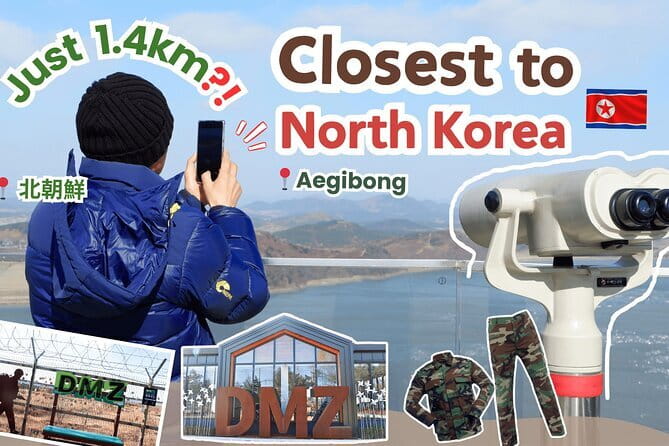
- North Korea is only 1.4 kilometers away: Jogang Observatory offers one of the closest public viewing points from South Korea.
- Aegibong has a personal story: Displaced people once came here to look toward their former hometowns across the border.
- The Starbucks is part of the setting: You can buy a drink at the observatory cafe, but coffee is not included in the tour price.
- The tree-shaped bridges carry a political history: They recall the huge Christmas tree once used at Aegibong, whose bright lights caused tension because of North Korea’s limited electricity.
- Passports are mandatory: Bring the original passport required for entry to the Civilian Control Zone.
- The trip starts and ends in Myeongdong: There is no hotel pickup or drop-off, so plan your own way to the meeting point and return.
Why Aegibong feels different from a standard DMZ trip
Many border excursions focus on military installations, tunnels, or formal observation areas. Aegibong offers a quieter and more emotional angle. You are not simply looking at a line on a map. You are visiting a place tied to families separated by war and a country divided for generations.
Aegibong Peace Ecopark was once known as Hill 154. Korean and North Korean forces fought fiercely here during the Korean War because of its position near the meeting point of the Hangang and Jogang Rivers. That location gave the hill military importance, but the meaning of the site later changed.
After the war, displaced people came to Aegibong to look toward the northern land and imagine the homes they had lost. For many people, the view was the nearest practical connection to family, villages, and memories they could no longer reach.
I find that context important because it keeps the observatory from becoming a simple photo stop. The view may look calm, but the calm is loaded with political and family history. Your guide can help explain that background, which is one reason the quality of the guide matters so much here.
More DMZ and border tours:
- Best DMZ Tour Korea from Seoul (Red Suspension Bridge Optional)
★ 5.0 · 41,422 reviews - DMZ Tour: 3rd Tunnel, Option(Suspension Bridge, Boat) from Seoul
★ 5.0 · 21,373 reviews - DMZ tour south Korea from Seoul (NK experience hall, defector)
★ 5.0 · 20,599 reviews
Jogang Observatory: a close look across the border
The old observatory opened in 1978. It was later demolished and replaced by the current Jogang Observatory, giving the site a newer setting for viewing North Korea from a very short distance.
The headline figure is striking: North Korea is about 1.4 kilometers away. That does not mean you will see every detail clearly. Weather and visibility matter, and this is a border view rather than a guaranteed close-up of a particular town or person. Still, the short distance gives the experience unusual force.
You will be looking into the Civilian Control Zone, an area with movement rules and security requirements. That is why your passport is not an optional form of identification. Keep it with you throughout the outing and check that the name used for booking matches your travel document.
The observatory also gives the day a slightly odd, very modern twist. A Starbucks operates inside the site, making it possible to drink a familiar coffee while facing one of the world’s most politically sensitive borders. Coffee is not included, so budget separately if you want to use the cafe.
I like this contrast. It is not polished into a theme-park experience. Instead, the cafe sits beside a place shaped by war, separation, and ongoing tension. You can pause with a drink, but the view outside keeps the larger story in focus.
The Christmas tree that became bridges
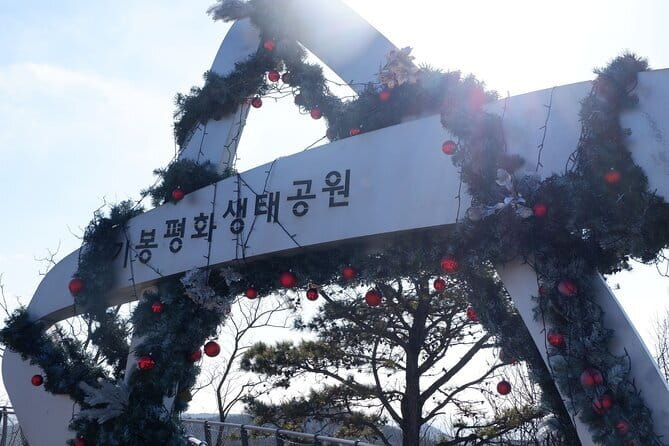
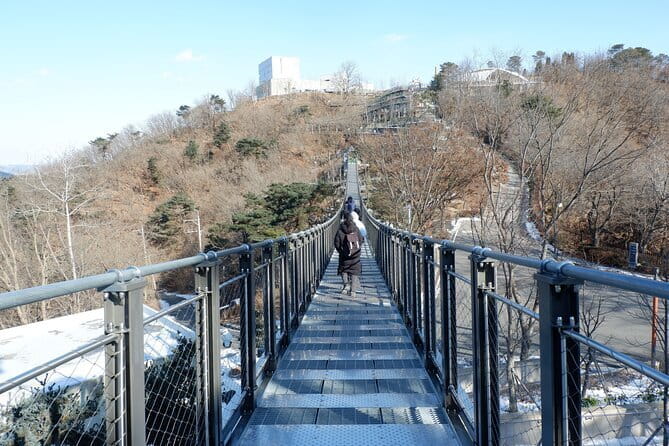
Aegibong was once known for a huge Christmas tree. Its lights could be seen from North Korea, but the display caused conflict because North Korea had very limited access to electricity. The tree was eventually removed.
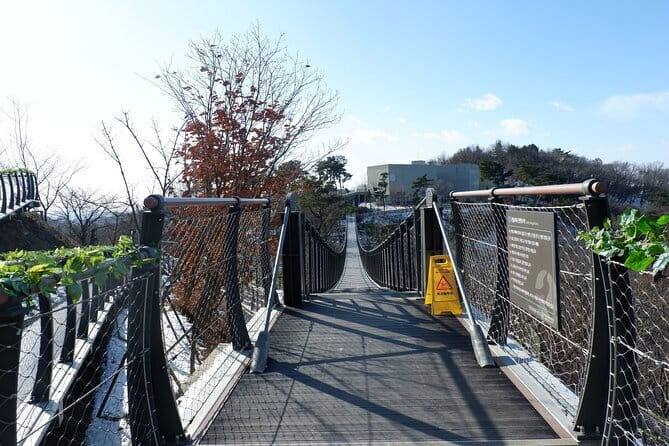
Workers at Aegibong later built bridges in the shape of a tree. These structures preserve the memory of the old display without repeating the same problem. The result is a small but telling example of how symbolism at the border can carry real political consequences.
Look for this detail during your visit. It is easy to treat the bridges as decorative architecture, but their shape refers to an older chapter in the site’s story. Your guide may connect the design to the larger goal of peace and harmony promoted by the ecopark.
The bridge area also gives the visit some movement. This is not only a building where you peer through windows and leave. You should expect some walking around the park and observatory area, so a moderate level of physical fitness is recommended.
What the guide adds to the experience
The tour can include a professional guide if you select the guided option. That choice is worth considering because the visual experience alone has limits. North Korea may appear distant or hazy, and without context, the observatory could feel like a brief look across water or fields.
Thomas receives especially strong praise for explaining the South Korean and North Korean conflict in clear, engaging terms. He is also described as friendly and helpful, with an ability to connect national history to the personal effect of division on South Koreans.
Sunny is another guide praised for being clear, caring, and well organized. Shin is also singled out for making the tour highly informative. Guide assignments can change, so you should not book on the assumption that one particular person will lead your departure, but these names give you a useful sense of the service style associated with the tour.
The best guides here do more than recite dates. They explain why Aegibong mattered during the war, why displaced people came to the hill, and how small gestures such as Christmas lights could become part of the conflict. That human scale makes the trip easier to understand.
More suspension bridge and cable car trips:
- Seoul: DMZ Tour with Optional Suspension Bridge
★ 4.8 · 5,277 reviews - Signature DMZ Tour: Exclusive Defector Talk & Suspension Bridge
★ 5.0 · 4,459 reviews - Ultimate Korea DMZ Tour from Seoul (Gondola & Suspension Bridge)
★ 5.0 · 2,396 reviews - DMZ; NK Defector, 3rd Tunnel, Suspension Bridge,Hotel pickup
★ 4.9 · 2,055 reviews
How the 4-hour-45-minute schedule works
The outing begins at a meeting point in Myeongdong, one of Seoul’s central areas. It ends at Myeongdong Station, which is helpful if you want to continue sightseeing or return to your accommodation by public transport.
An air-conditioned vehicle is included. The supplied schedule gives about 1 hour and 30 minutes for Aegibong Peace Ecopark, with admission included. The full 4-hour-45-minute duration also covers the journey between Seoul and the border area, although the exact driving time can vary.
That timing makes this a practical half-day addition to a Seoul itinerary. You do not need to surrender an entire day, and you can still have an evening free for dinner, shopping, or another city attraction.
The trade-off is that a group excursion follows its planned departure and return. The maximum group size is listed as 120 people, which is large enough that the feel may vary from a small personal walk to a sizable coach outing. If you care about close conversation with the guide, choose the guided option and stay attentive when explanations begin.
There is also a minimum of two participants. If that minimum is not met, the operator may cancel and offer another date, another experience, or a full refund.
Is the $48 price good value?

At $48 per person, this is a reasonable price for a specialized half-day trip from Seoul. Admission and air-conditioned transportation are included, and the tour takes you to a border location that is not as simple to visit independently as an ordinary city attraction.
The value is strongest if you want historical explanation and organized transport. You are paying for access, timing, and a guide option, not for a full meal or a long list of attractions. Lunch, snacks, drinks, travel insurance, and hotel transfers are excluded.
You should also treat the Starbucks as an optional extra, not a built-in refreshment stop. If you want coffee, bring money for the purchase. The cafe is memorable because of its location, but the drink itself is still your responsibility.
Group discounts may be available, making the tour more attractive for families or friends booking together. Since the activity is usually booked about 31 days ahead, popular dates may fill early. That does not guarantee every departure will sell out, but it is sensible to reserve before your Seoul schedule becomes crowded.
The limits of the border view
A clear day matters. The operator says the experience requires good weather, and poor conditions can lead to a different date or a full refund. This is fair, since fog, rain, or low visibility could reduce the observatory visit to a symbolic stop without much of a view.
You should also set your expectations correctly. The tour lets you see North Korea from a close point, but it does not promise a particular type of panorama or a detailed view of life across the border. The significance comes from the distance, the history, and the fact that you are looking at a restricted neighboring country.
The Civilian Control Zone setting also means this is not a completely casual outing. Bring your passport, follow instructions, and expect the guide or site staff to control where you can go. Those rules are part of visiting a sensitive border area, not a flaw in the tour.
Who will enjoy this tour most?
I would recommend it to you if you want a half-day outing with real historical weight but do not want a full-day DMZ program. It suits first-time visitors to Seoul who want to understand the division of Korea through one specific place rather than a rapid sequence of military-themed stops.
It is also a good choice if the Joint Security Area is unavailable. The tour does not replace the experience of entering a formal joint military zone, but it offers a close view of North Korea and a more reflective setting.
You will probably appreciate it most if you enjoy listening to a guide and thinking about the human consequences of political events. The trip is less suitable if you want a relaxed cafe visit, extensive shopping, or guaranteed sunshine.
Families and older visitors should consider the walking requirement and moderate fitness recommendation. The site includes outdoor areas and bridges, so comfortable shoes are sensible. The air-conditioned vehicle helps during the transfer, but it does not remove the need to walk at the ecopark.
Booking and cancellation advice
Confirmation is provided at booking. You can cancel for a full refund up to 24 hours before the local start time. Cancellations or changes made less than 24 hours before departure are not accepted for a refund.
The weather and minimum-participant rules are important when planning. If the operator cancels because of poor weather or too few participants, you can choose another date or experience, or receive a full refund.
Bring your passport and arrive at the Myeongdong meeting point with enough time to spare. Since hotel pickup is not included, allow time to reach the start location on your own.
FAQ
Where does the tour start?
The tour starts in Myeongdong, Jung District, Seoul, South Korea.
Where does the tour end?
The tour ends at Myeongdong Station.
How long does the experience last?
The tour lasts approximately 4 hours and 45 minutes.
Is admission to Aegibong Peace Ecopark included?
Yes, admission to Aegibong Peace Ecopark is included.
Is coffee at Starbucks included?
No. Coffee and other food or drinks are not included in the tour price.
Do I need to bring my passport?
Yes. Passports are mandatory for this experience.
Is hotel pickup and drop-off provided?
No. Hotel pickup and drop-off are not included.
What happens if the tour is canceled because of weather?
You will be offered a different date or a full refund if poor weather causes the experience to be canceled.
Should you book the Aegibong tour?
Book it if you want a compact, well-organized way to see North Korea from a very close point and understand why the view matters. The combination of Jogang Observatory, displaced-family history, the tree-shaped bridges, and a guide such as Thomas, Sunny, or Shin gives the outing more substance than a quick border photo.
Skip it if your main goal is a guaranteed dramatic panorama, a small private group, or a full military-zone visit. Weather can affect visibility, the group may be large, and the day requires your passport and some walking.
For many people, though, this is a strong value at $48. It offers a rare border view, useful historical context, and a manageable half-day schedule, with just enough Starbucks oddness to remind you that modern Seoul is never far away.
More Tower and Observatory Tickets
- Best Seoul City Tour (Gyeongbokgung Palace,Insadong,Namsan Tower)
★ 5.0 · 1,647 reviews - Seoul City Sightseeing Tour Including Gyeongbokgung Palace, N Seoul Tower, and Namsangol Hanok Village
★ 5.0 · 1,423 reviews - Seoul Highlights: Gyeongbok Palace, Insadong & N Seoul Tower
★ 4.7 · 726 reviews - Seoul: Sky Lotte World Tower Ticket
★ 4.7 · 209 reviews
Just added around Seoul
- Seoraksan National Park & Nami Island★ 4.5 · 3 reviews
- Strawberry Picking, Winter Sled with Eobi Ice Valley from Seoul★ 4.5 · 3 reviews
- Seoul Full Day small group Tour★ 5.0 · 3 reviews
- Majang Meat Market Experience: Private Tour with Han-woo Beef BBQ★ 5.0 · 3 reviews
- Seoul Korean BBQ Dinner Experience with Secret Food Tours★ 5.0 · 3 reviews
- Rice Wine Tasting with Sommelier – Finest Makgeolli (& Soju)★ 5.0 · 3 reviews
- Max Out Seoul: Must Visit City Highlights Panoramic Day Tour★ 5.0 · 3 reviews
- Seongsu-dong Walking Tour: K-Pop, Culture, Cheer, Friends & Relax★ 4.5 · 3 reviews
DMZ & Border Tours, compared.

Best DMZ Tour Korea from Seoul (Red Suspension Bridge Optional)
Read our review →
DMZ Tour: 3rd Tunnel, Option(Suspension Bridge, Boat) from Seoul
Read our review →
DMZ tour south Korea from Seoul (NK experience hall, defector)
Read our review →
DMZ Insider Tour: 3rd Tunnel, NK Defector Meet & Red Bridge
Read our review →

Signature DMZ Tour: Exclusive Defector Talk & Suspension Bridge
Read our review →
Thrilling Korean DMZ 3rd Tunnel Tour from Seoul + Red Bridge Rush
Read our review →DMZ Past and Present: Korean Demilitarized Zone Tour from Seoul
Read our review →Browse the lists this tour appears in