
Reviewed · DMZ & BORDER TOURS
[Private] DMZ & Imjingak Peace Gondola Experience Inter-Korean War
The border is closer than most people expect. I like the mix of serious history and clear vantage points, especially the Third Infiltration Tunnel and the gondola ride over Imjingang River. I also like that admission to the DMZ and gondola is covered, with guides such as JJ and Jackie praised for their patient, engaging explanations. The main drawback is the schedule: military controls, weather, and authorized-bus rules can change the day with little warning.
This is a long, early start from central Seoul, but it covers more ground than a simple border lookout visit. You will see memorial sites, a divided railway, a former military camp, and the view toward North Korea. Just remember your valid passport, sturdy sneakers, and a willingness to follow strict time limits.
In This Review
- Key points to know before booking
- Why this Seoul day trip matters
- Starting at 7:00 a.m. from central Seoul
- Imjingak and the first look at the border
- The Third Infiltration Tunnel requires real effort
- Dora Observatory and the view toward North Korea
- Dorasan Station and the hope of connection
- Dokgae Bridge and Bunker Beat 131
- The Imjingak Peace Gondola changes the pace
- Lunch and the final Seoul return
- Is $195 a fair price?
- Important changes, cancellations, and practical limits
- Who should book this experience?
- Should you book the DMZ and gondola tour?
- FAQ
- Where does the tour begin?
- Where does the tour end?
- How long does the experience last?
- Is a passport required?
- Is the Third Infiltration Tunnel physically difficult?
- What happens if the DMZ is closed?
- What is included in the price?
Key points to know before booking
![[Private] DMZ & Imjingak Peace Gondola Experience Inter-Korean War - Key points to know before booking](https://9.koreaescapes.com/wp-content/uploads/private-dmz-imjingak-peace-gondola-experience-inter-korean-war-1.jpg)
- The Third Tunnel is steep: You must lean forward in parts, and good physical fitness is required.
- The gondola adds a calmer view: From Imjingak, you can look toward Camp Greaves and the river rather than only visiting military checkpoints.
- Guides make a major difference: JJ and Jackie are singled out for patient, engaging explanations and helpful support.
- The day can change for security reasons: Military training, official events, poor weather, or conditions connected to North Korea may force a substitute itinerary.
- The tour begins at 7:00 a.m.: Meet at the President Hotel near Euljiro 1-ga Station Exit 8 and finish in Myeong-dong.
- The advertised price is $195 per person: That is a serious cost, but it includes transport, an English-speaking guide, DMZ admission, and gondola admission.
Why this Seoul day trip matters
The DMZ is not a normal sightseeing stop. It is a controlled border zone shaped by war, separation, and the continuing absence of a peace treaty between North and South Korea. The attraction is not a collection of grand buildings. It is the uneasy feeling of standing near a boundary that still carries military weight.
I find this tour useful because it gives you several ways to understand that division. You move from memorials and railway remains to underground military construction, then to lookout points and the gondola. Each stop offers a different angle, although some are more moving than others.
The day lasts about eight to ten hours. That sounds long, and it is. Still, the distance from Seoul, security checks, authorized transport, and waiting time help explain the length. You are not simply hopping between city attractions.
The group may be as large as 99 people, and everyone must use the authorized bus inside the DMZ. For that reason, the word private should not lead you to expect a completely personal border visit or flexible timing at every stop. The military zone sets the rules.
More Private Tours in Seoul
- Private DMZ Tour (No Shopping): 3rd Tunnel & Suspension Bridge
★ 5.0 · 607 reviews - Seoul City Private Full-Day Tour Including Lunch
★ 5.0 · 469 reviews - Private DMZ the 3rd Tunnel Tour from Seoul (optional Red Bridge)
★ 5.0 · 429 reviews
Starting at 7:00 a.m. from central Seoul
![[Private] DMZ & Imjingak Peace Gondola Experience Inter-Korean War - Starting at 7:00 a.m. from central Seoul](https://9.koreaescapes.com/wp-content/uploads/private-dmz-imjingak-peace-gondola-experience-inter-korean-war-2.jpg)
The meeting point is the President Hotel at 16 Eulji-ro in Jung District. Euljiro 1-ga subway station Exit 8 is nearby, so the start is practical if you are staying in central Seoul.
I would arrive early. A 7:00 a.m. departure leaves little room for a slow breakfast or a wrong turn in the station. The tour ends in Myeong-dong, which is convenient for dinner, shopping, and onward subway connections.
The air-conditioned vehicle matters on a full-day outing. You will spend a fair amount of time moving between sites, and the ride gives you a chance to rest after walking through the tunnel or waiting for security procedures.
The included English-speaking guide is central to the experience. JJ receives especially warm praise for making the subject engaging, while Jackie is noted for patience, clear information, and practical help. The strongest guides do more than recite dates. They help you understand why a broken bridge, an empty station, or a distant hillside matters.
Imjingak and the first look at the border
Imjingak Resort is the emotional gateway to the DMZ. Imjingak Pavilion, built in 1972, offers a broad view over the surrounding area and serves as a place for people to remember family members separated by the Korean War.
This is where the trip begins to feel less like a standard excursion. The area includes memorial displays and reminders of families who could not return home or reunite. The tone is often solemn, and you should give yourself time to read rather than treating the stop as a quick photo break.
The route continues across the Unification Bridge, followed by an identification check. You need a current, valid passport on the day of the tour. This is not a suggestion to ignore until the last minute. Without the required identification, you may not be allowed to continue.
At this point, the strict nature of the visit becomes clear. You must remain with the authorized bus and obey photo regulations. The rules can feel restrictive, but they are part of visiting an active military area rather than a regular public park.
The Third Infiltration Tunnel requires real effort
![[Private] DMZ & Imjingak Peace Gondola Experience Inter-Korean War - The Third Infiltration Tunnel requires real effort](https://9.koreaescapes.com/wp-content/uploads/private-dmz-imjingak-peace-gondola-experience-inter-korean-war-4.jpg)
The Third Infiltration Tunnel is one of the most memorable stops, but it is also the part that demands the most from you physically. It was built by North Korea for a possible invasion route into the South and later discovered by South Korean authorities.
The tunnel is steep. You must lean forward in sections, and the walk can be tiring, especially after an early start. Sneakers are required for safety, and this is not the place for sandals, smooth-soled shoes, or fashion footwear.
The tunnel itself is more about atmosphere than visual beauty. You will not find a polished museum experience underground. Instead, the narrow route gives you a physical sense of the work involved in cutting through rock close to the border.
Take the guide’s instructions seriously and keep your pace sensible. If you have limited mobility or dislike steep walking, this stop may be the hardest part of the day. The tour requires moderate physical fitness, and the tunnel is the clearest reason why.
More DMZ and border tours:
- Best DMZ Tour Korea from Seoul (Red Suspension Bridge Optional)
★ 5.0 · 41,422 reviews - DMZ Tour: 3rd Tunnel, Option(Suspension Bridge, Boat) from Seoul
★ 5.0 · 21,373 reviews - DMZ tour south Korea from Seoul (NK experience hall, defector)
★ 5.0 · 20,599 reviews - Seoul: DMZ Tour with Optional Suspension Bridge
★ 4.8 · 5,277 reviews
Dora Observatory and the view toward North Korea
![[Private] DMZ & Imjingak Peace Gondola Experience Inter-Korean War - Dora Observatory and the view toward North Korea](https://9.koreaescapes.com/wp-content/uploads/private-dmz-imjingak-peace-gondola-experience-inter-korean-war-5.jpg)
Dora Observatory gives you one of the tour’s defining moments: a view toward North Korea. Visibility depends heavily on weather. On a clear day, you may see across the border area, while fog or haze can reduce the view to a vague outline.
That uncertainty is part of the experience, but it can also disappoint if you arrive expecting a sharp panorama. The setting is significant even when the view is poor. You are looking from a controlled South Korean observation point toward a country that is physically close but politically distant.
Photo rules apply, and timing is controlled. You may not have unlimited time at the railings or viewing area, so listen carefully when the guide explains where photography is allowed. A long lens is not a substitute for clear weather.
I like this stop best when you treat it as a moment of reflection rather than a checklist photo. The value comes from the location and the context, not from guaranteed visual drama.
Dorasan Station and the hope of connection
![[Private] DMZ & Imjingak Peace Gondola Experience Inter-Korean War - Dorasan Station and the hope of connection](https://9.koreaescapes.com/wp-content/uploads/private-dmz-imjingak-peace-gondola-experience-inter-korean-war-6.jpg)
Dorasan Station represents a different side of the border story. It was built as part of a possible rail connection between South and North Korea, making it a symbol of hoped-for unification.
The station feels especially powerful because railways normally suggest movement, trade, and ordinary contact. Here, the idea of a train crossing the border remains tied to political conditions. The building’s purpose points toward a future that has not arrived.
Your guide can help connect this quiet station to the wider Korean division. Without explanation, you might simply see a clean, nearly empty transport site. With context, it becomes a reminder that infrastructure can express hope as clearly as speeches do.
The itinerary also includes a DMZ theater and exhibition hall. Displays are presented in several languages, including Korean, English, Japanese, and Chinese. That makes the exhibits easier to follow if you want more than a spoken explanation.
One especially affecting display concerns a letter written by a young man to his mother before his death. It gives the political story a human scale. You are no longer dealing only with borders, troop movements, and railway plans.
Dokgae Bridge and Bunker Beat 131
![[Private] DMZ & Imjingak Peace Gondola Experience Inter-Korean War - Dokgae Bridge and Bunker Beat 131](https://9.koreaescapes.com/wp-content/uploads/private-dmz-imjingak-peace-gondola-experience-inter-korean-war-7.jpg)
Back at Imjingak Resort, Dokgae Bridge gives you another physical reminder of separation. The northbound section of the Gyeongui Line railway bridge over the Imjingang River has remained broken for nearly 70 years.
A damaged bridge can say more than a long lecture. It once connected communities, and now its incomplete structure points to the division that interrupted normal travel. The stop takes about 40 minutes, giving you time to look closely and hear the local explanation.
Bunker Beat 131 offers a newer, more presentation-focused part of the day. The name refers to a former military bunker area adapted for visitors. Its purpose is to show how defensive sites can be interpreted through exhibits and cultural programming.
This stop may appeal more to some people than others. If you prefer original military locations and direct historical evidence, the tunnel and Dokgae Bridge may feel stronger. If you like museums and visual displays, Bunker Beat 131 adds another layer.
The Imjingak Peace Gondola changes the pace
![[Private] DMZ & Imjingak Peace Gondola Experience Inter-Korean War - The Imjingak Peace Gondola changes the pace](https://9.koreaescapes.com/wp-content/uploads/private-dmz-imjingak-peace-gondola-experience-inter-korean-war-8.jpg)
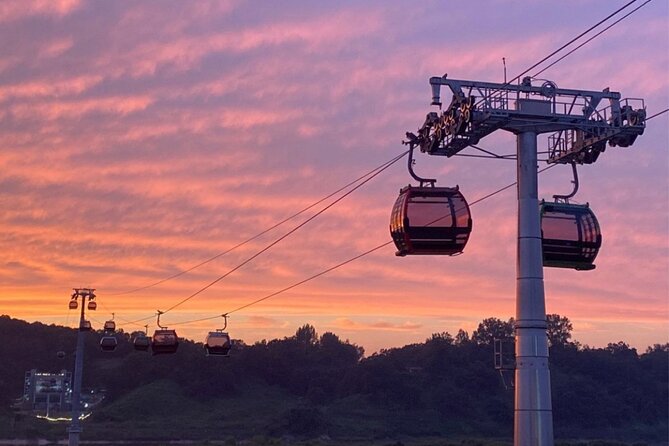
The Imjingak Peace Gondola is a welcome change after the formal checkpoints and tunnel walk. The ride takes about an hour as part of the overall visit and gives you a higher view over the river and border area.
You can also see Camp Greaves from the gondola. The former military site is known as a filming location for the Korean drama Descendants of the Sun. It was also associated with the 506th Regiment, a connection that adds interest for visitors familiar with the American series Band of Brothers or the film Saving Private Ryan.
The gondola is not only for drama fans. It gives you a broader sense of how close the sites are to one another and provides a less enclosed view after the underground tunnel. I like the change in pace, though weather again matters. Cloud, mist, or poor conditions can reduce what you see.
The ride is included in the price, which strengthens the value of this package compared with a basic DMZ bus trip. You get a different view of the area without adding another ticket at the end of the day.
Lunch and the final Seoul return
Lunch appears in the day’s sequence, but personal expenses are not included. Treat it as a point to clarify before departure. Ask what meal arrangement is planned and whether you should bring extra cash or a card.
After the final attractions, the route includes an amethyst or ginseng center before returning to Myeong-dong. This kind of retail stop is common on organized Korean tours. Some people enjoy browsing local products, while others may see it as time taken from the main subject.
You should factor this into your expectations. The tour is not a stripped-down military-history visit. It combines historical sites, scenic transport, interpretation, and a shopping stop. That broad program suits you if you want a full day with many elements. It may frustrate you if you want every minute focused on the DMZ.
Is $195 a fair price?
At $195 per person, this is not a budget outing. The price includes an air-conditioned vehicle, an English-speaking guide, DMZ admission, and gondola admission. It also saves you the trouble of arranging transport and navigating a controlled zone with changing access rules.
The value depends on what you want. If you only need a lookout and a quick explanation, the price may feel high. If you want the Third Tunnel, Dora Observatory, Dorasan Station, Dokgae Bridge, the exhibitions, and the gondola in one day, the package is easier to justify.
The guide is the biggest variable. JJ and Jackie are praised for being engaging, patient, attentive, and well informed. A good guide can turn waiting, security rules, and unfamiliar military terms into useful context. If your guide is less communicative, the day may feel more like transport between crowded stops.
Group discounts may help reduce the cost for larger parties. Since the maximum group size can reach 99, confirm the actual arrangement if group size matters to you. The tour is described as private, but the authorized-bus system means the DMZ portion remains controlled and structured.
Important changes, cancellations, and practical limits
The DMZ can close or change access because of military training, official events, North Korean developments, or poor weather. If that happens, the replacement route may include Tomorrow’s Whistle, Bunker Beat 131, Odusan Unification Tower, and the War Memorial of Korea.
That substitute can still offer useful context, but it is not the same as entering the DMZ. I would book this tour only if you can accept that possibility.
You can cancel for a full refund up to 24 hours before the start time. Changes or cancellations made within 24 hours are not accepted for a refund, and cut-off times use local Korean time.
Wear sneakers. Bring your passport. Expect rules, waiting, and fixed photo times. Children must travel with an adult, and everyone should be ready for moderate physical activity.
Who should book this experience?
I would recommend it to you if you want a serious, structured introduction to the Korean War and the continuing division of the peninsula. It suits first-time visitors to Seoul who want several major DMZ sights without arranging transport themselves.
It is also a good fit if you value explanation. The praised guides, especially JJ and Jackie, can make the difference between seeing a tunnel and understanding why it was built.
You may want another option if you dislike early starts, large groups, shopping stops, steep walking, or plans that can change because of military conditions. The day is not leisurely, and there is little room to wander at your own pace.
Should you book the DMZ and gondola tour?
Book it if you want the fullest listed mix of DMZ stops, including the Third Tunnel, Dora Observatory, Dorasan Station, Dokgae Bridge, exhibitions, and the Imjingak Peace Gondola. The price is high, but the included transport, admissions, and guide support make it reasonable for a full day.
Skip it if your main goal is a relaxed scenic ride or a short border visit. Before paying, confirm the pickup details, the meaning of the private arrangement, the lunch plan, and what substitute route applies if the DMZ closes.
FAQ
Where does the tour begin?
It begins at 7:00 a.m. at the President Hotel, 16 Eulji-ro, Jung District, Seoul. Euljiro 1-ga subway station Exit 8 is nearby.
Where does the tour end?
The tour ends in Myeong-dong, in Seoul’s Jung District.
How long does the experience last?
The full experience takes approximately eight to ten hours.
Is a passport required?
Yes. Every participant must bring a current, valid passport on the day of travel.
Is the Third Infiltration Tunnel physically difficult?
Yes. The tunnel is quite steep, requires you to lean forward in sections, and calls for good physical fitness. Sneakers are required.
What happens if the DMZ is closed?
If military training, an official event, North Korean developments, or other conditions prevent access, the tour may be replaced with Tomorrow’s Whistle, Bunker Beat 131, Odusan Unification Tower, and the War Memorial of Korea.
What is included in the price?
The price includes an air-conditioned vehicle, an English-speaking guide, and admission fees for the DMZ and Imjingak Peace Gondola. Personal expenses are not included.
Just added around Seoul
- Seoraksan National Park & Nami Island★ 4.5 · 3 reviews
- Strawberry Picking, Winter Sled with Eobi Ice Valley from Seoul★ 4.5 · 3 reviews
- Seoul Full Day small group Tour★ 5.0 · 3 reviews
- Majang Meat Market Experience: Private Tour with Han-woo Beef BBQ★ 5.0 · 3 reviews
- Seoul Korean BBQ Dinner Experience with Secret Food Tours★ 5.0 · 3 reviews
- Rice Wine Tasting with Sommelier – Finest Makgeolli (& Soju)★ 5.0 · 3 reviews
- Max Out Seoul: Must Visit City Highlights Panoramic Day Tour★ 5.0 · 3 reviews
- Seongsu-dong Walking Tour: K-Pop, Culture, Cheer, Friends & Relax★ 4.5 · 3 reviews
DMZ & Border Tours, compared.

Best DMZ Tour Korea from Seoul (Red Suspension Bridge Optional)
Read our review →
DMZ Tour: 3rd Tunnel, Option(Suspension Bridge, Boat) from Seoul
Read our review →
DMZ tour south Korea from Seoul (NK experience hall, defector)
Read our review →
DMZ Insider Tour: 3rd Tunnel, NK Defector Meet & Red Bridge
Read our review →

Signature DMZ Tour: Exclusive Defector Talk & Suspension Bridge
Read our review →
Thrilling Korean DMZ 3rd Tunnel Tour from Seoul + Red Bridge Rush
Read our review →DMZ Past and Present: Korean Demilitarized Zone Tour from Seoul
Read our review →Browse the lists this tour appears in