
Reviewed · HISTORICAL TOURS
Jeju Day Tour – World Heritage & UNESCO
Jeju rewards a full day. This private tour links volcanic wonders with waterfalls, beaches, and UNESCO sites, giving you a useful first look at the island without the hassle of renting a car. I like the door-to-door pickup and the freedom of traveling with only your own group. I also like the choice of stops based on whether you start in Seogwipo or Jeju City. The main drawback is simple: eight or nine hours is a lot of ground to cover, so some stops feel like quick introductions rather than slow explorations.
The tour costs $320 per group of up to four people, with fuel, parking, insurance, and transport included. That can be good value for a small group, especially when a regular taxi or private minivan would otherwise need to be arranged separately. Entrance fees, lunch, drinks, and personal expenses are extra, and the route changes depending on your pickup city.
In This Review
- Key things to know before booking
- Starting from Seogwipo: Jeju’s dramatic south coast
- Oedolgae and the start of Olle Trail 7
- Cheonjiyeon Falls: a wooded break in Seogwipo
- Jeongbang Falls, where water meets the sea
- Seongsan Ilchulbong: the day’s big volcanic sight
- Jusangjeolli Cliff and the changing south coast
- O’sulloc Tea Museum as the Seogwipo choice
- Starting from Jeju City: beaches, lava, and the east
- Hamdeok Beach and its emerald water
- Manjanggul Cave and its UNESCO geology
- Woljeongri Beach and a short café stop
- Seopjikoji or Seongeup Folk Village
- Transport, group size, and the role of the driver
- Is $320 good value for four people?
- Who should book this Jeju day tour?
- Final verdict: a practical first look at Jeju
- FAQ
- How long does the Jeju UNESCO day tour last?
- How many people can join the private tour?
- Is pickup and drop-off included?
- What is included in the $320 group price?
- Are entrance fees included?
- Is lunch included?
- What happens if Manjanggul Cave is closed?
- Which route is used from Seogwipo?
- Which route is used from Jeju City?
Key things to know before booking
- Two different routes: Seogwipo departures focus on Oedolgae, waterfalls, Seongsan Ilchulbong, Jusangjeolli Cliff, and a choice of Manjanggul Cave or O’sulloc. Jeju City departures include Hamdeok Beach, Manjanggul Cave, Woljeongri Beach, Seongsan Ilchulbong, and a choice of Seopjikoji or Seongeup Folk Village.
- Private transport for your group: Up to four people use a regular taxi. Larger parties use a jumbo taxi, minivan, or mini-bus.
- The strongest natural sights: Seongsan Ilchulbong, Jeongbang Falls, and Oedolgae offer very different views of Jeju’s volcanic coast.
- Manjanggul Cave needs checking: The cave is closed for safety inspection and construction through August 31, 2025, with another attraction offered instead.
- The driver matters: Simple English, Japanese, or Chinese is offered. One praised driver, Mr. Hyun-woo Lee, was noted for adjusting the pickup time and helping make the day run smoothly.
- Extra costs add up: Jeongbang Falls, Jusangjeolli, Seongsan Ilchulbong, and Manjanggul Cave require separate admission fees.
Starting from Seogwipo: Jeju’s dramatic south coast
If you are staying in Seogwipo, the route begins with some of the island’s best coastal sights. Your day includes Oedolgae, Cheonjiyeon Falls, Jeongbang Falls, Seongsan Ilchulbong, Jusangjeolli Cliff, and one choice between Manjanggul Cave and O’sulloc.
This route makes sense for anyone based on Jeju’s southern side. It combines short walks with major sights, though you should expect a busy schedule. The pickup and drop-off arrangement is especially useful here because the sights are spread across the island.
More historical tours:
- Jeju Island UNESCO Heritage Bus Tour
★ 5.0 · 54 reviews - Private Full Day Tour World Natural Heritage & UNESCO in jeju
★ 5.0 · 9 reviews - Jeju UNESCO Natural Heritage Private Tour by Certified Guide
★ 5.0 · 5 reviews
Oedolgae and the start of Olle Trail 7
Oedolgae is a 20-meter stone pillar rising from the sea. It is separated from the shore, which gives it an isolated, almost theatrical appearance. Waves break around the dark rock while the path offers views along the coast.
This is also the starting point of Jeju Olle Trail Course 7. You do not walk the full trail on this tour, but the stop gives you a taste of the walking routes that make Jeju so enjoyable. Allow about an hour here.
The rock is known by several names, including General Stone and Grandma Rock. Local stories connect it with General Choi Yeong and a woman waiting for someone at sea. The legends add a human side to what might otherwise be just another attractive rock formation.
I would use this stop to walk rather than simply snap a photo and return to the vehicle. The sea air, birds, and coastal path are part of the appeal. The drawback is that the trail can feel brief if you want a longer walk.
Cheonjiyeon Falls: a wooded break in Seogwipo
Cheonjiyeon Falls is reached by a path through a green valley. The water drops 22 meters from a rock cliff, creating a strong roar that you hear before the full view opens up.
The name means sky connected with land. The valley supports temperate plants, including camellias, brambles, and the protected Elaeocarpus tree. The area is also known for giant mottled eels, which are nocturnal and therefore unlikely to be the main attraction during a daytime visit.
This is a pleasant contrast to Oedolgae. At the coast, you get wind and open water. Here, the path feels shaded and enclosed. Since no separate stop duration is specified, your actual time will depend on the day’s pace and traffic.
Jeongbang Falls, where water meets the sea
Jeongbang Falls is one of Jeju’s three well-known waterfalls, along with Cheonjiyeon and Cheonjeyeon. Its special feature is easy to remember: the water drops directly into the sea.
The falls are about 23 meters high, and two streams pour over a dark cliff. Pine trees and steep rock surround the viewpoint, giving the site a more rugged feel than Cheonjiyeon. Plan on roughly 40 minutes.
The walk down to the falls and the rocky area near the water require care. The admission fee is not included, so keep some money available for entry. This is one of the stops where the extra cost feels justified if you enjoy natural scenery, but you may not want to pay for every paid attraction if your main goal is a quick overview of Jeju.
More Jeju trips:
- Jeju: Eastern Jeju UNESCO Spots Day Tour
★ 4.9 · 1,148 reviews - Jeju: Western and Southern Sightseeing Day Tour
★ 4.8 · 972 reviews - East Jeju Essentials – Seongsan Ilchulbong (UNESCO) & Haenyeo
★ 5.0 · 939 reviews - Jeju: Southern Top UNESCO Spots Bus Tour
★ 4.9 · 648 reviews
Seongsan Ilchulbong: the day’s big volcanic sight
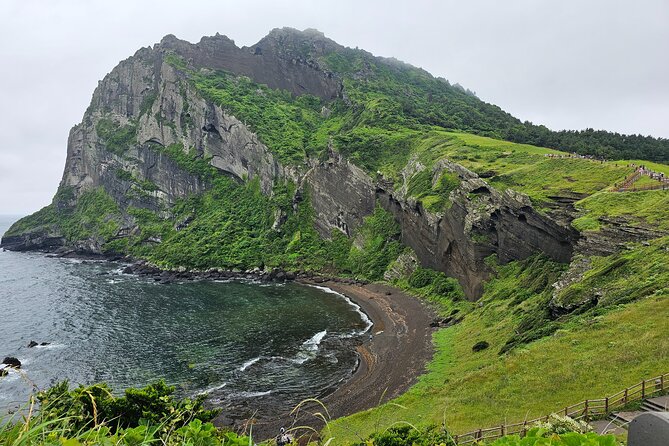
Seongsan Ilchulbong is the centerpiece of the route. This tuff cone formed around 5,000 years ago from an eruption beneath the sea. Its broad crater rises above the surrounding coast and gives Jeju one of its most recognizable views.
The stop lasts about an hour, and the admission fee is extra. That time may be enough for a shorter walk and photos, but it may not allow a relaxed summit visit if the path is busy or you walk slowly. The tour description recommends walking one of the local routes, including the Seongsan-Ojo Trail or Jijil Trail.
If you reach the summit, you can look into the volcanic crater and out across the sea. The site is famous for sunrise, but this day tour does not promise a sunrise departure. You should treat it as a daytime visit unless you arrange a different pickup time in advance.
The peak is a UNESCO site and a designated geopark area, but the value is not just the label. You can see how volcanic activity shaped Jeju, then compare this cone with the lava tube and coastal cliffs visited elsewhere in the day.
Jusangjeolli Cliff and the changing south coast
Jusangjeolli Cliff is included on the Seogwipo route, with the entrance fee paid separately. The supplied details do not give a fixed stop length, so your time here may vary.
The cliffs are known for their column-like volcanic formations along the coast. This stop works well beside Jeongbang Falls because both show how volcanic rock meets the sea in different ways. If you have a strong interest in geology, ask the driver how much time is available here before the day gets too tight.
O’sulloc Tea Museum as the Seogwipo choice
From Seogwipo, the alternative to Manjanggul Cave is O’sulloc Tea Museum. It sits beside the Seogwang tea fields and opened in 2001 as a place for learning about Korean tea culture.
The museum blends a tea exhibition area, a nature-friendly rest space, and a café serving tea-based food and drinks. The visit lasts about 50 minutes and admission is free.
O’sulloc is the gentler choice. You can slow down, browse, and take a break after the outdoor stops. It is also more forgiving if the weather is poor. The tradeoff is that it does not offer the same geological drama as a lava tube, and café purchases are your responsibility.
Starting from Jeju City: beaches, lava, and the east
The Jeju City route has a different rhythm. It includes Hamdeok Beach, Manjanggul Cave, Woljeongri Beach, Seongsan Ilchulbong, and a choice of Seopjikoji or Seongeup Folk Village.
This version suits you if you are staying near Jeju City or the airport side of the island. It gives more time to the northeast coast, with several stops built around sea views and cafés. The route is attractive, but the number of stops means you should not expect long beach stays.
Hamdeok Beach and its emerald water
Hamdeok Beach is about 20 kilometers from Jeju Airport and is known for white sand, clear water, and a strong green-blue color. Seoubong Peak rises beside the beach, giving the shore more shape than a flat strip of sand.
The tour allows about 30 minutes. That is enough for a walk and photographs, but not a full beach day. Tall palm trees and nearby Olle Course 19 add to the holiday feel.
Hamdeok is a good early stop because it gives you a quick sense of Jeju’s east coast. If you want to swim, sit by the water, or visit several cafés, you will need more time than this tour provides.
Manjanggul Cave and its UNESCO geology
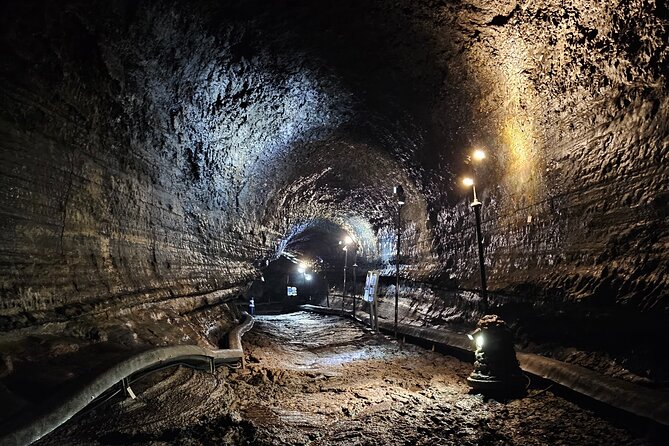
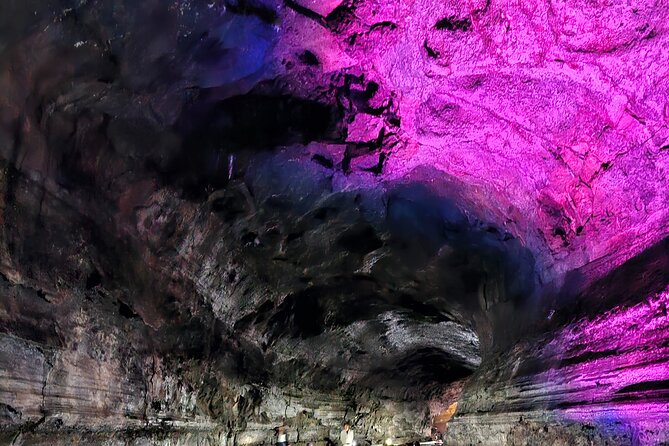
Manjanggul Lava Tube is part of the Geomunoreum volcanic system, the only parasitic cone on Jeju designated as a UNESCO World Natural Heritage site. More than 20 caves lie within the oreum, though only Manjanggul has been open to the public.
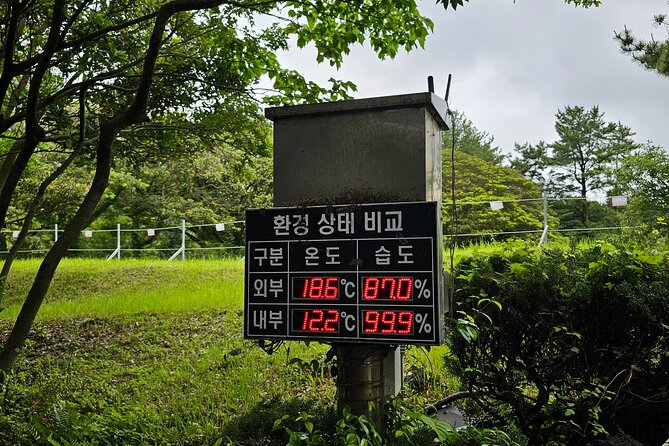
Inside, the temperature stays between 11 and 21 degrees Celsius depending on conditions and season. The tunnel contains lava formations, unusual rock textures, and a large stone pillar marking the public route’s end.
The planned visit lasts about an hour. Wear sensible shoes and bring a light layer if you dislike cool, damp spaces. The walk is the point of the visit, so do not expect a polished museum experience. The cave is raw, dark, and shaped by volcanic forces.
A crucial practical note: Manjanggul Cave is listed as closed for safety inspection and internal construction from December 29, 2023, through August 31, 2025. During that period, another place replaces it. The stated alternative for the regular monthly closure is Jeju Haenyeo Museum, which is offered when the cave is closed on the first Wednesday of the month. Confirm the current arrangement before booking if the cave is important to you.
Woljeongri Beach and a short café stop
Woljeongri Beach is known for white sand, clear emerald water, and a road lined with tea houses and coffee shops. The tour allows only 15 minutes, so think of it as a scenic pause rather than a full beach visit.
I would use the time for a quick look at the shore and a few photographs. If you want coffee, the short schedule may make that difficult unless the driver confirms a longer stop.
Woljeongri pairs nicely with Hamdeok. Hamdeok feels broader and more beach-focused, while Woljeongri adds a café-lined coastal road. Together, they show two sides of Jeju’s northeast shore.
Seopjikoji or Seongeup Folk Village
After Seongsan Ilchulbong, you choose between Seopjikoji and Seongeup Folk Village.
Seopjikoji is a cape whose name refers to a small piece of land projecting into the sea. A 40-minute visit lets you walk toward a white lighthouse with the dark sea behind it. Jeju ponies may be grazing on the grass, though wildlife sightings are never guaranteed.
The cape also has the Glasshouse and Yumin Art Gallery, buildings designed by Tadao Ando. If you want open coastal views and a short walk, Seopjikoji is the better choice.
Seongeup Folk Village offers a different kind of Jeju experience. It preserves the living site of old Jeju residents and remains a working village where people still live. It has Important Folklore Cultural Heritage status, and residents act as volunteer guides.
The stop lasts about 20 minutes, so you will see only a small part of the village. Look for the old saw-leaf zelkova and Japanese hackberry trees near the center. Choose Seongeup if traditional village life interests you more than cliffs and sea views.
Transport, group size, and the role of the driver
This is a private tour, so only your group participates. Up to four people ride in a regular taxi. Groups of five or more use a jumbo taxi or minivan, while groups of nine or more use a mini-bus.
Fuel and parking are included, which matters on a long island route. You avoid arranging several taxis and can return to the same vehicle after each stop. Pickup and drop-off are offered across Jeju Island.
The driver speaks simple English, Japanese, or Chinese. Do not expect a full museum-style guide at every stop. The strongest value comes from transport, route planning, and local assistance rather than long lectures.
The experience can also depend on the driver’s attitude. Mr. Hyun-woo Lee received particular praise for accommodating an earlier 7:30 a.m. pickup arranged with manager Hong-min Lee. His English was described as workable, and his flexibility helped turn a fixed itinerary into a smoother day. That is useful information if you care about communication and timing.
Is $320 good value for four people?
At $320 per group, the price works out to $80 per person for four people before admission fees, meals, and drinks. For two people, the per-person cost is much higher, but you still receive private transport, pickup, fuel, parking, and insurance for a full day.
The value is strongest for families or small groups that do not want to drive. Jeju’s sights are spread out, and a private vehicle saves time between beaches, waterfalls, and volcanic sites. It also lets you ask about an earlier pickup, as one group successfully did.
The price is less attractive if you are a solo visitor or a couple comfortable using public transport. You also need to budget for the paid entries at Jeongbang Falls, Jusangjeolli, Seongsan Ilchulbong, and Manjanggul Cave when it is open.
Who should book this Jeju day tour?
I would recommend it to first-time visitors who want to see several major sights in one day. It is also a good fit for families, small groups, and anyone staying in Seogwipo or Jeju City without a rental car.
You will like it if you prefer a private vehicle, short walks, scenic stops, and a flexible choice between cultural and natural attractions. You may not like it if you want long hikes, a slow beach day, or detailed guiding at every site.
The best booking decision depends on your base. Choose the Seogwipo departure for waterfalls, Oedolgae, Jusangjeolli, and the south coast. Choose Jeju City for Hamdeok, Woljeongri, Manjanggul, and the eastern shore.
Free cancellation is available up to 24 hours before the start time. Changes or cancellations within 24 hours are not accepted for a refund. Most people can participate, but the itinerary includes walking at waterfalls, beaches, cliffs, and volcanic sites, so plan your footwear accordingly.
Final verdict: a practical first look at Jeju
This tour packs Jeju’s main natural themes into one private day: lava tubes, volcanic cones, sea cliffs, waterfalls, beaches, and tea culture. It does not give you enough time to linger everywhere, but it does help you decide which places deserve a longer return visit.
I would book it for a small group that values convenience and wants a broad introduction to the island. I would skip it only if you already have a car, prefer independent pacing, or want to spend a full day at one or two major sites.
FAQ
How long does the Jeju UNESCO day tour last?
The tour lasts approximately eight to nine hours.
How many people can join the private tour?
Up to four people use a regular taxi. Groups of five or more use a jumbo taxi or minivan, and groups of nine or more use a mini-bus.
Is pickup and drop-off included?
Yes. Pickup and drop-off services are offered from locations on Jeju Island.
What is included in the $320 group price?
The price includes private transportation, fuel, parking fees, and insurance. Simple English, Japanese, or Chinese driver assistance is provided.
Are entrance fees included?
No. Admission fees for Jeongbang Falls, Jusangjeolli, Seongsan Ilchulbong, and Manjanggul Cave are not included.
Is lunch included?
No. Lunch, food, drinks, and personal expenses are separate.
What happens if Manjanggul Cave is closed?
Jeju Haenyeo Museum is offered as an alternative when the cave is closed on the first Wednesday of the month. Manjanggul Cave is also listed as closed for safety inspection and internal construction through August 31, 2025, with another replacement site provided.
Which route is used from Seogwipo?
The Seogwipo route includes Seongsan Ilchulbong, Oedolgae, Jeongbang Falls, Jusangjeolli Cliff, and a choice between Manjanggul Cave and O’sulloc Tea Museum.
Which route is used from Jeju City?
The Jeju City route includes Hamdeok Beach, Manjanggul Cave, Woljeongri Beach, Seongsan Ilchulbong, and a choice between Seopjikoji and Seongeup Folk Village.
Just added around Jeju
- East of jeju tour for Seogwipo Gangjeong Cruise Customers★ 4.5 · 3 reviews
- Seogwipo(the southern city of Jeju) Art Museum Walking Tour★ 5.0 · 3 reviews
- Private Tour in South Jeju including Yacht Cruise★ 5.0 · 3 reviews
- Jeju Island, Seongsan Ilchulbong, Discover Scuba Diving★ 4.5 · 3 reviews
- Jeju: Western & Southern Jeju Hydrangea Festival Tour★ 5.0 · 3 reviews
- Jeju: Small Group Tour w/Pink Muhly & Tangerine Picking★ 5.0 · 3 reviews
- Jeju: Hiking Mt. Hallasan, South Korea’s Highest Mountain★ 5.0 · 3 reviews
- Jeju: BTS Are You Sure?! Filming Locations Private Taxi Tour★ 5.0 · 3 reviews
Historical Tours, compared.

Gyeongju UNESCO World Heritage Guided Day Tour
Read our review →
Gyeongju UNESCO World Heritage Guided Day Tour from Busan
Read our review →
Evening Dark History, Folklore & Ghost Story Walking Tour
Read our review →
Old Korea Thousand History Tour of Gyeongju from Busan
Read our review →
Hanbok Photoshoot and History Tour at Gyeongbokgung Palace
Read our review →

UNESCO Heritage Tour Including Bulguksa Temple
Read our review →
Gyeongju UNESCO World Heritage Sites and History Full-Day Tour with Lunch
Read our review →Browse the lists this tour appears in