
Reviewed · GYEONGJU HERITAGE TOURS
Busan: Winter Healing Park and (Gyeongju/Daegu) One Day Tour
Snow makes southern Korea feel surprisingly wild. This 11-hour outing combines the icy fun of Gyeongju Kookmin Healing Park with either historic Gyeongju or food-focused Daegu. I like the choice between two routes, and I like that round-trip transport, guides, and admission fees are included. Guides Amy, Sophie, and Lee have earned praise for thoughtful help, clear explanations, and taking excellent photos.
The main consideration is the long day. Traffic can affect the schedule, the canoe ride costs extra in cash, and the Daegu route changes its final nature stop according to ice conditions. Still, at $65 per person, this is a useful way to reach places that would take more planning on your own.
In This Review
- Five things to know before booking
- Why this 11-hour winter outing works
- Starting with ice at Kookmin Healing Park
- The Gyeongju route: temple, village, cafes, and bridge
- Bulguksa Temple and Silla-era craftsmanship
- Gyochon Traditional Village and the Choi clan
- Hwangridan Street for snacks and modern Gyeongju
- Woljeong Bridge at the end of the day
- The Daegu route: market food and a changeable ice stop
- Seomun Market and lunch on your own
- Songhae Park or Biseulsan Recreational Forest
- What the guide adds to the day
- Is $65 good value?
- Timing, comfort, and small planning details
- Which route should you choose?
- Should you book this Busan winter tour?
- FAQ
- How long is the tour?
- What destinations can I choose from?
- What is included in the price?
- Are meals included?
- Is the canoe ride included?
- How much does the canoe cost?
- Which places are visited on the Gyeongju route?
- Which places are visited on the Daegu route?
- What languages are available for the guide?
Five things to know before booking
- The winter park comes first: Sledding, canoeing, icy paths, and frozen scenery give the day an active start.
- You choose Gyeongju or Daegu: One route is heavy on temples and old neighborhoods, while the other adds Seomun Market and a winter nature stop.
- The canoe is optional: It costs KRW 30,000 for a one to four-seat canoe or KRW 50,000 for a five to eight-seat canoe, paid in cash.
- Gyeongju packs in major sights: Bulguksa Temple, Gyochon Traditional Village, Hwangridan Street, and Woljeong Bridge follow the park visit.
- The Daegu nature stop is weather dependent: The final stop may be Songhae Park at Okyeon Reservoir or Biseulsan Recreational Forest.
- The guides add real value: Amy, Sophie, and Lee were praised for local explanations, care, recommendations, and taking good photographs.
Why this 11-hour winter outing works
Busan is a great base for southern Korea, but its city setting does not give you an easy taste of snowy mountain scenery or the old capital of Silla. This tour solves that problem in one very full day. You board transport in Busan, visit the winter park, then follow one of two routes into North Gyeongsang Province.
The structure is simple: shared transportation, a guide speaking English, Chinese, or Korean, and admission fees handled as part of the booking. That matters because the destinations are spread out, and arranging all of them by public transport would take more effort.
I would think of this as a sightseeing day with a winter activity in the middle, not as a slow retreat. You will move from one stop to the next, and traffic may alter the timing. The reward is variety. In a single outing, you can ride a sled, walk near ice, see one of Korea’s best-known Buddhist temples, eat at a traditional market, or photograph a historic bridge lit by winter light.
More Day Trips in Busan
- Busan: Gyeongju Guided Day Trip to Three Kingdoms Capital
★ 4.8 · 1,925 reviews - 1-Day Busan Shore Excursion – City Highlights for Cruise Guests
★ 4.5 · 36 reviews - 7 Highlights Gyeongju City One Day Small Group Tour from Busan
★ 5.0 · 24 reviews
Starting with ice at Kookmin Healing Park
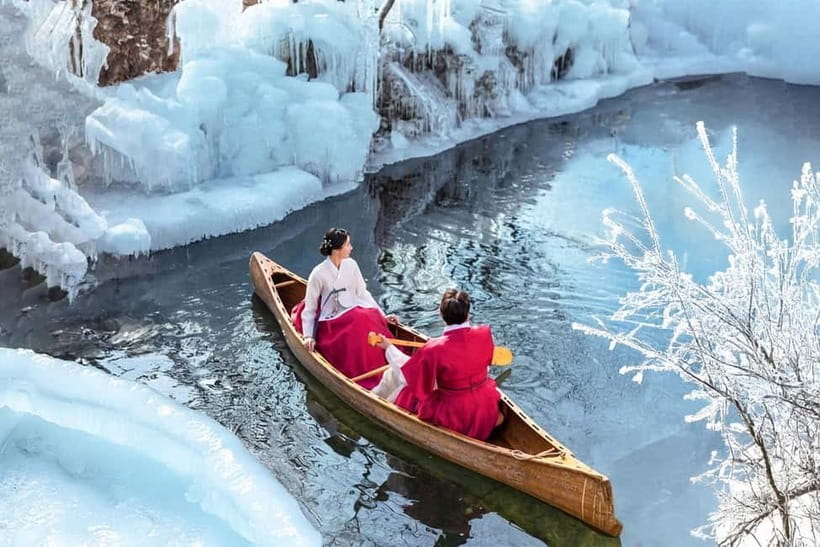
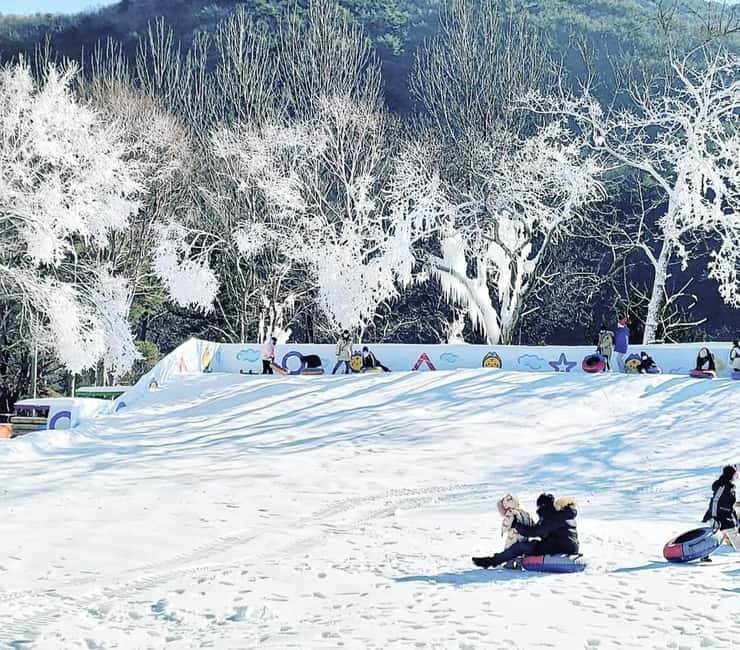
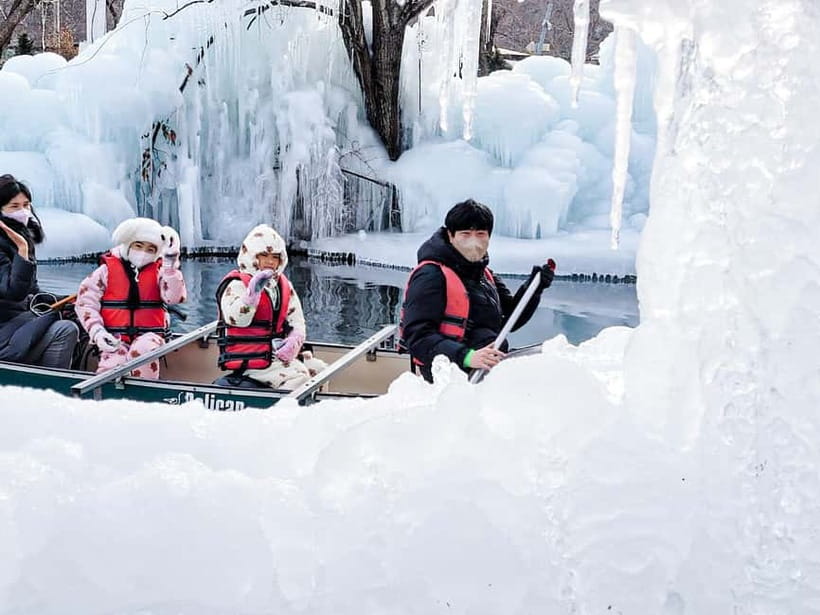
The first major stop is Gyeongju Kookmin Healing Park, presented as a snowy winter setting with frozen scenery and icy paths. The main activities are sled rides, scenic canoeing, and walks beside the ice.
The park gives the trip an immediate sense of occasion. You are not simply stepping off a bus at another historic site. You get a chance to play in the snow and see a colder side of Korea that is easy to miss if you stay in Busan.
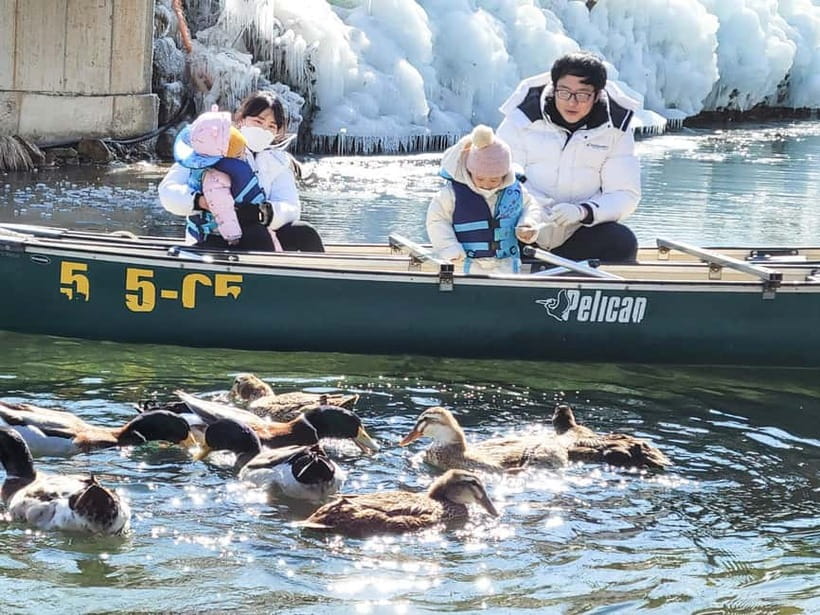
The canoe ride is optional, so you can decide after seeing the conditions and the setting. The fee is not included. A one to four-seat canoe costs KRW 30,000, while a five to eight-seat canoe costs KRW 50,000. Payment is made on site in cash. If canoeing is one of your main reasons for booking, bring enough Korean won and treat it as an additional activity rather than part of the advertised $65 price.
Sledding may suit families and anyone who wants a lighthearted winter activity. The icy walks are better for a quieter pause, especially if you prefer taking photographs and enjoying the cold air at your own pace. The exact balance between activities will depend on conditions and the day’s schedule.
A practical point: snow and ice can make outdoor visits less comfortable. Wear warm layers and shoes with a good grip. The tour information does not specify equipment rental or changing facilities, so do not plan on a polished indoor resort experience. This is an outdoor park visit, and that is part of its appeal.
The Gyeongju route: temple, village, cafes, and bridge
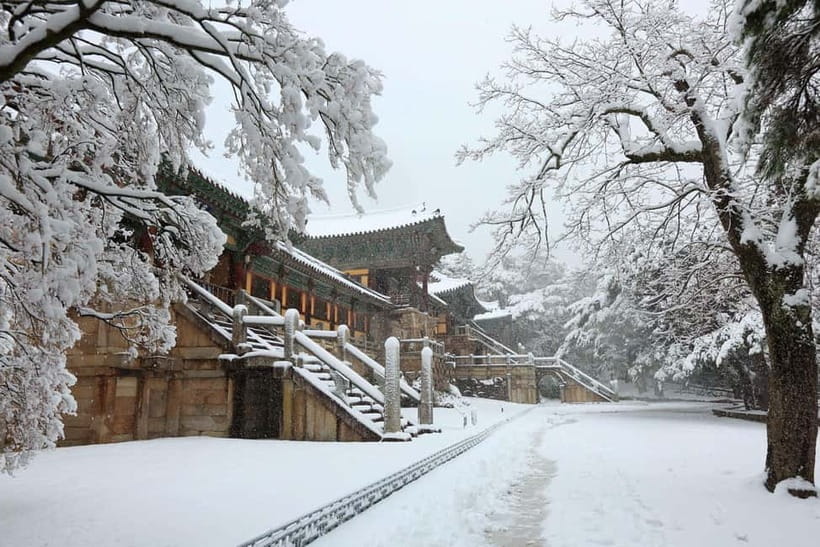
Choose the Gyeongju option if you want the strongest history content. After the winter park, the route visits Bulguksa Temple, Gyochon Traditional Village, Hwangridan Street, and Woljeong Bridge.
Bulguksa Temple and Silla-era craftsmanship
Bulguksa is the historical anchor of this route. It is a major Gyeongju landmark and was designated a UNESCO World Cultural Asset in 1995. The site is known for the temple buildings and the finely made stone features that surround them.
This is where a guide can make a real difference. Without context, a temple visit can become a quick photo stop. With explanations about the site and its artistic details, you get a clearer sense of why Bulguksa matters in Korean history.
Allow yourself to look beyond the largest buildings. Stone steps, pagodas, and carved details are central to the experience. Winter may also give the grounds a quieter, more subdued appearance, though weather can make walking less easy.
The drawback is time. This is not a dedicated Bulguksa tour, so you should expect an overview rather than an exhaustive examination of every corner. If Bulguksa is your top priority, an independent visit would give you more freedom. If you want it combined with several other stops, this route is efficient.
A few more trips of this kind worth comparing:
- [OFFICIAL] Eden Valley Resort Winter Ski Day Tour from Busan
★ 4.5 · 20 reviews - Jisan Ski Resort from Seoul by Shuttle(Opt Winter Skiing Package)
★ 5.0 · 194 reviews - Seoul: Elysian Gangchon Winter Ski Resort Fun Day Tour
★ 4.6 · 25 reviews - Elysian Gangchon Winter Ski + Eobi Ice Valley Day Tour fr Seoul
★ 4.5 · 17 reviews
Gyochon Traditional Village and the Choi clan
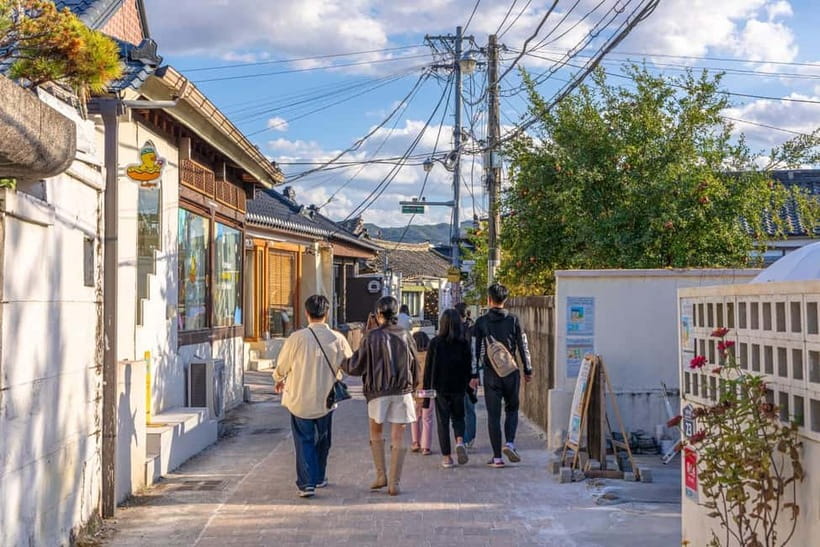
Gyochon Traditional Village offers a different kind of history. The village is connected with the Gyeongju Choi Clan, a family known for maintaining its wealth across 12 generations and producing influential figures.
That detail gives the village a useful human angle. You are not only looking at old-style homes. You are hearing about a family and the social world that shaped this part of Gyeongju.
I like this stop because it breaks up the grand scale of Bulguksa. A temple can feel monumental, while a village lets you consider daily life, family identity, and local traditions. The visit should appeal to you if you prefer history with a personal story attached.
Hwangridan Street for snacks and modern Gyeongju
Hwangridan Street brings the day into present-day Gyeongju. It has street food, cafes, and newer shops, making it a good contrast to the temple and traditional village.
This is a practical place to sample something small or take a break with a drink. The tour does not include meals, so food purchases are your responsibility. Come prepared to pay for anything you eat here.
The stop may feel more commercial than the historic locations. That is not necessarily a flaw. It gives you a look at how Gyeongju presents its past alongside current cafe and food culture. If you want only ancient sites, this will be the least traditional stop. If you appreciate a snack and a modern pause, it helps keep the itinerary from becoming a string of formal monuments.
Woljeong Bridge at the end of the day
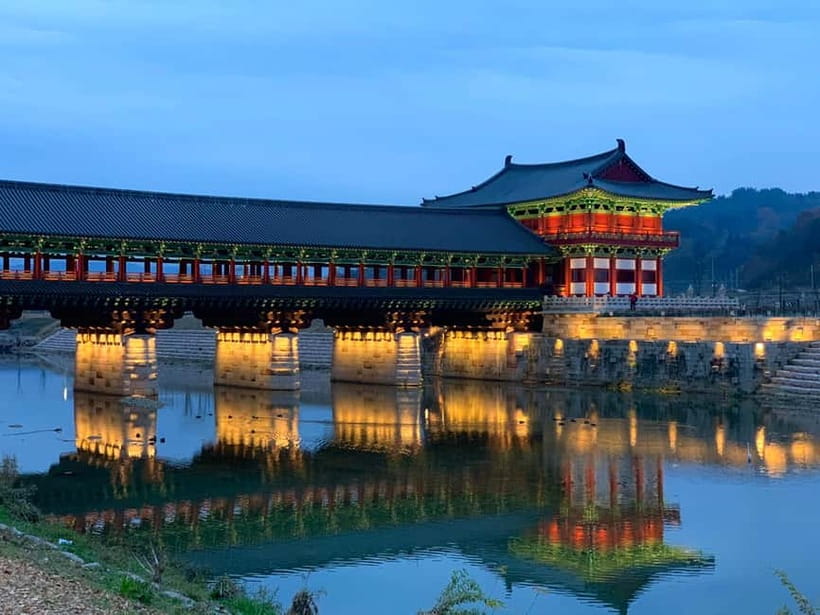
The final Gyeongju sight is Woljeong Bridge, an old crossing made with stone arches. Its construction reflects ancient engineering, and its position makes it a memorable closing photo stop.
Visiting the bridge late in the route is sensible. After the temple, village, and street, the bridge offers a final visual landmark before the return to Busan. The exact light and atmosphere will depend on the season, weather, and timing.
The Gyeongju route is the better choice for first-time visitors who want a broad introduction to the city. You get major heritage, a family-centered village, modern food culture, and a historic bridge. The tradeoff is a busy schedule with limited time at each place.
The Daegu route: market food and a changeable ice stop
Pick the Daegu option if local food and a second nature stop interest you more than a full day of Gyeongju monuments. After Kookmin Healing Park, the route continues to Seomun Market, followed by either Songhae Park at Okyeon Reservoir or Biseulsan Recreational Forest.
Seomun Market and lunch on your own
Seomun Market is the food stop. Its stalls offer street food, local dishes, crafts, and other goods. Lunch is not included, so this is where you choose what to eat and pay directly.
A market visit gives you more control than a fixed group meal. You can spend your budget on a full lunch, several snacks, or something you have never tried before. The tradeoff is that the group schedule may not allow a long, leisurely meal.
I would choose this route if you enjoy browsing and eating more than visiting formal historic sites. The market also gives the day a more everyday feel. Instead of only seeing monuments selected for their importance, you get a taste of a working city market and its food culture.
Songhae Park or Biseulsan Recreational Forest
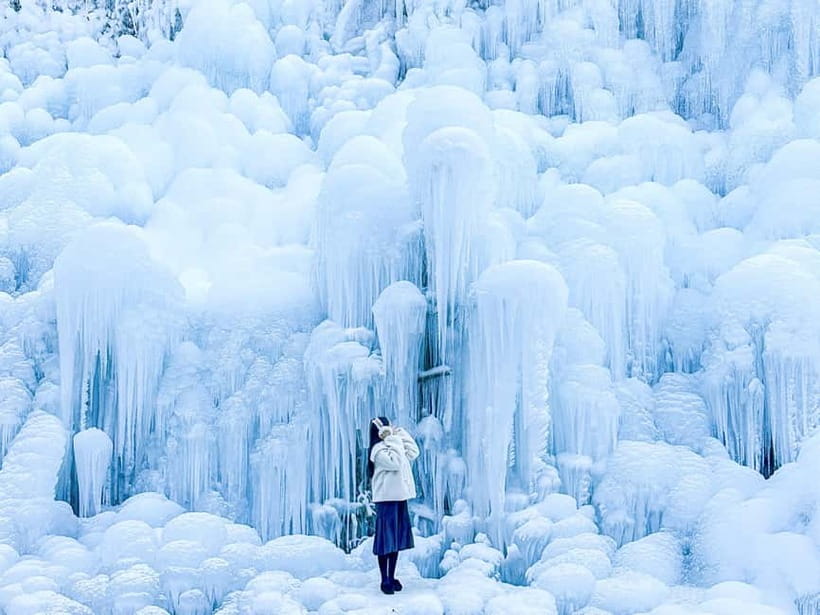
The final stop changes according to ice conditions. You may visit the frozen wall at Songhae Park near Okyeon Reservoir, or go to Biseulsan Recreational Forest.
This flexibility is important. The tour cannot promise one fixed winter scene because ice depends on weather. If conditions are right, you may see frozen water, icy trails, and a stream with frozen sections. The setting is meant for short walks, photographs, and a peaceful look at winter outdoors.
The uncertainty is also the main drawback of the Daegu option. If you have your heart set on one specific location, this route cannot guarantee it. On the other hand, the change protects the quality of the experience. The final stop is selected with ice conditions in mind rather than forcing the group to visit an unsuitable site.
Compared with the Gyeongju route, the Daegu option has less historical sightseeing. It is a better fit if you want a market meal and a second outdoor setting after the park.
What the guide adds to the day
A long regional day trip is easier when someone else handles directions, timing, and explanations. The guide service is available in English, Chinese, and Korean, so check the language offered with your selected departure.
Several guides have been singled out for different strengths. Amy was praised for her explanations, useful recommendations, and taking wonderful photos. Sophie was described as caring and attentive. Lee was noted for being kind, explaining the sites clearly, and taking good photographs.
That last point is more useful than it may sound. A full-day group outing often means you are juggling scenery, winter clothing, and a phone camera. Help with photographs can save you from returning with only hurried snapshots. The comments about recommendations also suggest that the guide can help you make better use of short breaks.
A guide cannot remove every limitation. Group travel means you follow a shared timetable, and explanations may be less detailed than those on a private tour. Still, for a day covering several destinations, the guiding and transport are a major part of the value.
Is $65 good value?
At $65 per person, the tour is priced reasonably for an 11-hour outing that includes round-trip transportation from Busan, admission fees, and a live guide. The distance matters. You are not paying only for entry to a park or temple. You are also paying to avoid arranging transport between Busan, Gyeongju or Daegu, and the winter sites.
You should budget extra for food, personal purchases, and the canoe. Travel insurance is not included. The canoe charge is the most important optional cost: KRW 30,000 for one to four seats or KRW 50,000 for five to eight seats, paid in cash at the park.
The value is strongest if you want variety and do not want to rent a car or plan connections yourself. It is weaker if you prefer to linger at one temple, spend hours at a market, or set your own pace. The itinerary covers a lot, but it does not offer a slow, unstructured day.
Timing, comfort, and small planning details
The listed duration is 11 hours, or 810 minutes. That is a full day, so plan around the length before booking. Traffic and weather can change the route timing, and the meeting point may differ depending on the option you select.
Tell the operator in advance if you are bringing a baby stroller. An infant can join free of charge, but no seat is provided. That is an important detail for families, especially on a long day involving outdoor paths and winter conditions.
Cancellation is flexible up to 24 hours before departure for a full refund, and you can reserve now and pay later. These policies help if your Busan plans are still shifting, but they do not change the practical need to check the exact meeting point and start time for your chosen route.
Which route should you choose?
Choose Gyeongju Winter if you want temples, old neighborhoods, cultural context, and a historic bridge. Bulguksa is the strongest reason to select it, while Gyochon Village and Hwangridan Street provide useful variety.
Choose Daegu Winter if Seomun Market sounds more appealing than a temple visit, or if you want food and nature in roughly equal measure. Just accept that the final ice location may change.
For families, couples, and first-time visitors, the winter park adds fun to what could otherwise be a serious cultural day. For photographers, the combination of snow, ice, old stonework, and bridge views offers plenty to work with. For anyone needing a relaxed schedule or guaranteed weather, the 11-hour format and changing conditions deserve careful thought.
Should you book this Busan winter tour?
I would book it if you want an easy, value-conscious day beyond Busan and like having several experiences packed together. The strongest features are the choice of two routes, the winter park activities, and guides who help with history, recommendations, and photographs.
Choose Gyeongju for the more rewarding cultural day. Choose Daegu for market food and flexible winter scenery. Bring warm clothing, cash for the canoe and meals, and realistic expectations about a long group schedule. If that sounds right, $65 buys a lot of southern Korea in one day.
FAQ
How long is the tour?
The tour lasts 11 hours, listed as 810 minutes.
What destinations can I choose from?
You can choose a Gyeongju winter route or a Daegu winter route after visiting Gyeongju Kookmin Healing Park.
What is included in the price?
Round-trip transportation from Busan, English and Chinese-speaking staff, and admission fees are included.
Are meals included?
No. Meals are not included, and personal food expenses are paid separately.
Is the canoe ride included?
No. The canoe is optional and paid for in cash on site.
How much does the canoe cost?
A one to four-seat canoe costs KRW 30,000. A five to eight-seat canoe costs KRW 50,000.
Which places are visited on the Gyeongju route?
The route includes Bulguksa Temple, Gyochon Traditional Village, Hwangridan Street, and Woljeong Bridge after the winter park.
Which places are visited on the Daegu route?
The route includes Seomun Market and either Songhae Park at Okyeon Reservoir or Biseulsan Recreational Forest, depending on ice conditions.
What languages are available for the guide?
Live guiding is available in English, Chinese, and Korean.
More Busan Trips
- Small Group Full Day Busan Tour (Max 6 Pax)
★ 5.0 · 1,464 reviews - From Busan: Gyeongju UNESCO World Heritage Guided Day Tour
★ 4.8 · 1,250 reviews - Busan Private Tour with licensed tour guide + private vehicle
★ 5.0 · 1,143 reviews - Busan: Coastal Treasures Beach Train, Culture Village & More
★ 4.7 · 832 reviews
More Day Trips
- Jinhae Cherry Blossom Day trip from Busan – A Spring Adventure!
★ 4.5 · 13 reviews - Naejangsan National Park Autumn Foliage One Day Tour from Busan
★ 5.0 · 12 reviews - Busan: 7 Highlights Gyeongju City One Day Tour
★ 4.9 · 10 reviews - Busan Day Trip from Seoul by KTX – Private Tour with Local Guide
★ 5.0 · 9 reviews
Just added around Busan
- Korean UNESCO World Heritage Tour including Gyeongju, Andong and Daegu(2N3D)★ 5.0 · 3 reviews
- Busan Bliss: Panoramic Yacht & Urban Exploration with Sky Capsule★ 5.0 · 3 reviews
- Busan day trip including Gamcheon culture village from Seoul by KTX train★ 5.0 · 3 reviews
- Busan Seafood Tour : Oyster village Tour with Oyster cuisines★ 5.0 · 3 reviews
- 1 Day Private Busan Guided Tour★ 4.5 · 3 reviews
- 2-DAYS Busan Customized and Included Night tour★ 5.0 · 3 reviews
- Full-Day Jinhae Cherry Blossom festival Private tour★ 5.0 · 3 reviews
- Busan Dialect Class with local snack★ 5.0 · 3 reviews
Gyeongju Heritage Tours, compared.

Gyeongju Guided Day Trip to Three Kingdoms Capital
Read our review →
Gyeongju UNESCO World Heritage Guided Day Tour
Read our review →
Gyeongju UNESCO World Heritage Guided Day Tour from Busan
Read our review →
Old Korea Thousand History Tour of Gyeongju from Busan
Read our review →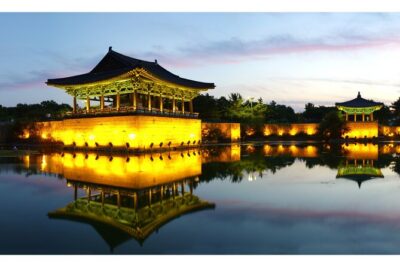
Gyeongju UNESCO sites Private tour with licensed tour guide
Read our review →
Private Gyeongju Tour – Explore Gyeongju UNESCO Sites
Read our review →
Gyeongju UNESCO Legacy Tour with National Museum
Read our review →
UNESCO Heritage Tour Including Bulguksa Temple
Read our review →Browse the lists this tour appears in