

Reviewed · GYEONGJU HERITAGE TOURS
Gyeongju Private Tour with hidden gem by local tour guide
Gyeongju rewards a full day. This private tour makes the ancient Silla capital easier to manage, with an English-speaking local guide and driver, hotel pickup, and a clean air-conditioned vehicle. I like the custom itinerary, which lets you spend more time at the places that matter to you, and I like the chance to eat tteokgalbi in Gyeongju rather than stopping at a generic roadside restaurant. The main drawback is pace: fitting ten possible stops into 8 to 10 hours can leave some places feeling rushed.
The tour is priced at $250 per person, so it is not a budget day trip, especially since entrance fees and meals are extra. Still, the private vehicle, tolls, parking, licensed guide, and door-to-door service can make the cost sensible for families or small groups that value time and personal attention. Past guests singled out guides Jay Song, John, and Mr. Goh for their flexibility, excellent English, and clear explanations of Korean history and Buddhism.
In This Review
- Key points to know before booking
- Why a private day trip from Busan makes sense
- Bulguksa Temple begins the Silla story
- Seokguram Grotto and a Gyeongju lunch
- Silla Arts and Science Museum adds a different view
- Daereungwon and Cheomseongdae reveal Silla power and science
- Gyochon Village brings history down to street level
- Donggung Palace and Wolji Pond after dark
- Yangdong Folk Village is the route’s wider excursion
- Gyeongju National Museum supplies the original objects
- Woljeonggyo Bridge closes the architectural sequence
- What $250 per person really buys
- How to plan the day without rushing
- Who will get the most from this tour
- Should you book the Gyeongju private tour?
- FAQ
- How long does the Gyeongju private tour last?
- Is hotel pickup and drop-off included?
- Are entrance fees included?
- Is lunch included?
- Can the itinerary be customized?
- Is an optional KTX package available?
Key points to know before booking
- A private guide and driver handle the long Gyeongju day, so you avoid organizing several distant sights by public transport.
- You can shape the route around your interests, with time available for temples, tombs, museums, villages, or historic architecture.
- Bulguksa Temple and Seokguram Grotto form the strongest opening, combining grand Buddhist buildings with detailed stone sculpture.
- The central Silla sites are close enough to link efficiently, including Daereungwon, Cheomseongdae, Gyochon Village, and Woljeonggyo Bridge.
- Yangdong Folk Village is a useful choice for a less urban stop, but adding it to every other sight may make the day feel crowded.
- Admission fees and lunch are not included, so keep extra money and a little flexibility for the final plan.
Why a private day trip from Busan makes sense
Gyeongju is one of South Korea’s most rewarding history stops, but its sights are spread across a wide area. A private vehicle removes much of the friction. You are picked up at your hotel, driven between sites, and returned afterward, with parking fees and tolls covered.
That matters on an 8 to 10 hour schedule. You are not spending part of your day finding the next bus or working out which stop serves a distant temple. You can also ask your guide to adjust the day as you go. If a temple deserves more time, another stop can be shortened.
The experience is designed for one private group only. That gives you a quieter rhythm than a large coach tour. Families can ask for a more child-friendly pace, and couples or friends can focus on the parts of Gyeongju they care about most.
The guide is also the driver, which keeps the arrangement simple. The available guides have received especially strong praise for being friendly, flexible, and easy to talk with. Jay Song customized a day around her group’s needs, while John was described as personable and adaptable. Mr. Goh earned particular praise for his English and his explanations of Buddhism.
More Private Tours in Busan
- Busan Private Tour with licensed tour guide + private vehicle
★ 5.0 · 1,143 reviews - Private Busan Tour -Explore Cultural Landmarks with a Local Guide
★ 5.0 · 552 reviews - Busan Hidden Gems Private Tour and Car Service
★ 5.0 · 113 reviews
Bulguksa Temple begins the Silla story

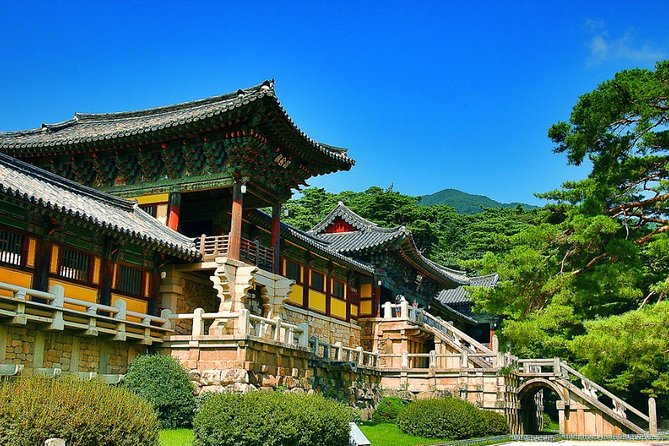
Bulguksa is the right first major stop because it gives you a physical sense of Silla ambition. The temple is a UNESCO World Heritage site and is recognized as a major work of Buddhist art in East Asia. You will see layered stone terraces, traditional buildings, and temple grounds that change character with the seasons.
Allow about an hour here. That is enough for a useful visit, though not enough for a slow study of every detail. Your guide can help explain the Buddhist meaning behind the layout and point out why the temple matters beyond its attractive roofs and courtyards.
Spring brings cherry blossoms, while autumn brings colorful foliage. Those seasonal details affect how much time you may want outdoors. Bulguksa is also a place where comfortable shoes help, since temple grounds involve walking and some uneven surfaces.
Admission is not included, so budget separately for the entrance fee. The tour’s flexibility is useful here. If Bulguksa is a personal priority, you can ask to give it more attention and trim a less important stop later.
Seokguram Grotto and a Gyeongju lunch
From Bulguksa, the day continues to Seokguram Grotto. This site is known for its carved Buddhist figures, including devas, bodhisattvas, and disciples set around the central sculpture. The grotto offers a more focused artistic experience than Bulguksa, with attention shifting from broad temple grounds to stone carving and religious imagery.
The planned visit lasts about an hour. Your guide’s role is especially useful here, since a short explanation can help you understand the figures and the Buddhist ideas behind them. One guest found Mr. Goh’s background in Buddhism particularly helpful, and that kind of explanation can make Seokguram more meaningful than a quick photo stop.
Lunch follows with tteokgalbi, grilled short rib patties associated with the local food experience in Gyeongju. Meals are not included in the price, and the tour description does not give a fixed restaurant or menu beyond this dish. A vegetarian option is available if you request it when booking.
This is a good point to tell the guide about food needs early. Do not wait until lunchtime if you have dietary restrictions. The meal adds a local touch, but you should treat it as an additional expense.
Silla Arts and Science Museum adds a different view
The Silla Arts and Science Museum breaks up the temples and outdoor monuments. Here you can watch an animated film about the thousand-year Silla Kingdom and get a more structured introduction to the period.
The museum is scheduled for about an hour. It may suit you if you prefer visual storytelling or if children need a change from ruins and formal religious sites. The animated presentation also gives context before the tour reaches the tombs, observatory, and museum collections later in the day.
The description presents the show as a major attraction, but the exact presentation can matter to different people in different ways. If you prefer original artifacts to animation, you might choose to spend less time here and give that time to the Gyeongju National Museum.
This is where a private tour earns its keep. You do not have to follow a fixed group schedule. You can tell the guide whether your group would rather watch the full presentation or move on.
More Private Tours in Gyeongju
- Gyeongju The UNESCO World heritage sites tour(Private tour)
★ 5.0 · 17 reviews - 3-Days 2-Nights Gyeongju UNESCO Sites & Busan City [Private Tour from Seoul]
★ 4.5 · 11 reviews - UNESCO World Heritage Gyeongju & Busan Two-city Private Tour.
★ 5.0 · 7 reviews - Full Day Private car tour to UNESCO Gyeongju&Yangdong village
★ 5.0 · 5 reviews
Daereungwon and Cheomseongdae reveal Silla power and science

Daereungwon Tomb Complex is one of the clearest places to see how Silla rulers were commemorated. Large ancient tombs belonging to kings and nobles rise across the grounds, giving you a strong visual sense of status and ceremony.
The planned stop is only 30 minutes. That is enough for a walk and photographs, but you should not expect a detailed archaeological visit. If ancient burial customs interest you, ask for extra time and reduce one of the later stops.
Cheomseongdae Observatory is nearby, making it an efficient pairing. Its name means star-gazing tower, and it is described as the oldest surviving astronomical observatory in Asia. The tower is compact, so the 30-minute visit works well when combined with Daereungwon.
The value here is not size. Cheomseongdae is a reminder that Silla was not only a kingdom of tombs and temples. Scientific observation also had a place in court life. The site is free to visit, which helps offset the admission charges at other stops.
Gyochon Village brings history down to street level

Gyeongju Gyochon Traditional Village offers a change from royal monuments. You will see older historic buildings alongside newly built hanok, or traditional Korean houses. The point is to consider how people lived, worked, and organized daily life in a historic setting.
The visit lasts about an hour and is free. It works well after Daereungwon and Cheomseongdae because the three stops create a natural progression: royal burial grounds, scientific achievement, and ordinary domestic surroundings.
I would use this hour at an easy pace. Look at the architecture, walk the lanes, and ask your guide how the village functioned in earlier periods. The tour description does not promise a particular workshop or hands-on activity, so think of Gyochon as a walking and cultural stop rather than an organized demonstration.
The mix of old and newer hanok is part of the appeal, but it also means this is not a preserved site frozen entirely in the past. You are seeing history interpreted for modern visitors, which is useful but different from visiting an untouched village.
Donggung Palace and Wolji Pond after dark
Donggung Palace and Wolji Pond, also known as Anapji, is one of the most scenic stops on the route. The pond belonged to the Silla palace complex, and the site is especially known for its night view.
Timing matters here. The stop lasts about an hour, but the atmosphere depends heavily on daylight and darkness. If you want the famous illuminated view, tell the guide when planning the day. A schedule that reaches the pond too early may give you a fine daytime visit but not the full evening effect.
Admission is not included. The site is worth considering even if you are not focused on photography, because water, palace remains, and evening lighting create a different mood from the open tomb complex.
This is also one reason the flexible format matters. The guide can arrange the order around the time of year and the desired light, within the limits of the day. Since weather can affect the experience, keep in mind that the tour requires suitable conditions.
Yangdong Folk Village is the route’s wider excursion
Yangdong Folk Village is a UNESCO-listed traditional Korean village and offers another look at historic homes and community life. It is farther removed from the central cluster of Gyeongju sights, so adding it changes the character of the day.
The scheduled visit is one hour, with admission extra. I would choose Yangdong if traditional village architecture is a top interest. I would think twice about adding it if you want long visits at Bulguksa, Seokguram, the museum, and Donggung Palace and Wolji Pond.
This is the clearest example of the tour’s flexibility being both a strength and a practical challenge. The menu of stops is generous, but the clock is not. You cannot give every site a deep visit in one day. Ask your guide to build a priority list rather than simply trying to collect all ten stops.
Gyeongju National Museum supplies the original objects
The Gyeongju National Museum is the best stop for seeing genuine Silla artifacts. After temples, tombs, and reconstructed or preserved buildings, the museum lets you look closely at objects connected with the kingdom itself.
Admission is free, and the planned visit is one hour. For many people, this will be the most helpful place for understanding what daily life, ritual, art, and government looked like in Silla. I would especially favor it if you want more than photographs and scenic views.
The museum also gives you a quieter indoor period in the middle of a long day. That can be welcome in hot, cold, or wet weather, although the experience is still affected by the tour’s overall timing.
If you must choose between the museum and the Silla Arts and Science Museum, I would choose the National Museum for original material. The animated film may be better for a broad introduction, while the museum offers a closer look at the surviving objects.
Woljeonggyo Bridge closes the architectural sequence
Woljeonggyo Bridge is a short 20-minute stop, but it works well as a final architectural view. The bridge once connected the palace area with the pond, and its setting combines historic design with views of water and nature.
Because the visit is brief and free, it is easy to add without placing a major burden on the schedule. It also pairs naturally with Donggung Palace and Wolji Pond, helping you see how the palace complex was connected.
Do not expect a long guided visit here. This is a compact stop for photographs and a final look at Gyeongju’s old royal setting. Its value comes from the connection between sites, not from the amount of time spent on the bridge itself.
What $250 per person really buys
At $250 per person, this is a premium private day rather than a low-cost sightseeing shuttle. Your payment covers hotel pickup and drop-off, an English-speaking licensed guide, an air-conditioned vehicle, bottled water, parking fees, and tolls. Those included services are important when you are traveling from Busan and trying to cover a large area in one day.
Entrance fees, lunch, and activities outside the agreed plan are extra. That means you should calculate the total cost honestly before booking. The price makes the most sense for a small group that can share the private vehicle and values a custom schedule.
There is also an optional KTX package for travel from Seoul to Gyeongju and back to Seoul in an economy seat. Confirm exactly how that option affects the total price and meeting arrangements before paying, since the main tour is presented as a Busan-based experience.
Group discounts may be available. Ask for the current rate if you are booking for several people. A private tour can become better value when divided among a group, particularly if public transport would require several connections and extra planning.
How to plan the day without rushing
The greatest risk is trying to visit every listed stop. Ten locations, lunch, driving, entrance procedures, and hotel transfers will use the full 8 to 10 hours. Some visits are set at only 20 or 30 minutes, and the longer one-hour stops will still feel selective rather than thorough.
I would divide the sights into priorities:
- Choose Bulguksa and Seokguram for Buddhist art.
- Choose Daereungwon and Cheomseongdae for royal Silla landmarks.
- Choose the National Museum for original artifacts.
- Choose Gyochon or Yangdong for traditional village life.
- Choose Donggung Palace and Wolji Pond for evening scenery.
- Choose Woljeonggyo Bridge as a short architectural addition.
Tell the guide your top three interests before departure. You can still add nearby stops if time allows, but a clear plan will produce a better day than chasing every point on the map.
The tour requires good weather. If poor conditions cause cancellation, you are offered another date or a full refund. For your own comfort, bring practical walking shoes and plan for time outdoors, especially at the temples, tombs, observatory, and villages.
Who will get the most from this tour
I would recommend this experience to families, first-time visitors to Gyeongju, and small groups staying in Busan. It is also a good fit if you want historical explanation in English instead of trying to piece together the meaning of each site alone.
Children may appreciate the private format because the guide can adjust the pace. One past group specifically found the guide accommodating with children. The museum film may also provide a useful change of pace.
History fans should book with a short priority list. The guides have been praised for explaining Korean history and Buddhism clearly, but you still need to decide how much time you want in museums, temples, and villages.
I would be less enthusiastic about this tour if you want a slow, unstructured day or prefer to explore each site independently. The private format gives you control, but the long list of possible stops can tempt you into an overpacked schedule.
Cancellation is free up to 24 hours before the start time for a full refund. Changes made within 24 hours are not accepted, and the weather rule applies, so check the local cut-off time before making last-minute plans.
Should you book the Gyeongju private tour?
Book it if you want to see major Silla sites from Busan without managing the transport yourself. The strongest reasons are the private vehicle, flexible route, licensed local guide, and the chance to shape the day around Buddhist art, royal history, museums, or traditional villages.
The guides are the real deciding factor. Jay Song, John, and Mr. Goh have each been praised for personal service, clear English, flexibility, and cultural explanation. Ask for your preferred focus when booking, but remember that guide assignment may depend on availability.
Skip it if $250 per person feels too high after adding lunch and admission fees, or if you would rather spend a full day at only two or three sites. For everyone else, this is a practical way to turn a spread-out historic region into a manageable and personal day.
FAQ
How long does the Gyeongju private tour last?
The tour lasts approximately 8 to 10 hours, including the scheduled visits and transportation.
Is hotel pickup and drop-off included?
Yes. Hotel pickup and drop-off are included, along with an air-conditioned vehicle, bottled water, parking fees, and tolls.
Are entrance fees included?
No. Admission fees are not included for sites where an entrance charge applies. Cheomseongdae Observatory, Gyochon Village, the Gyeongju National Museum, and Woljeonggyo Bridge are listed as free.
Is lunch included?
No. Meals are not included. The planned lunch is tteokgalbi, or grilled short rib patties. A vegetarian option is available if you request it when booking.
Can the itinerary be customized?
Yes. The itinerary is flexible, and you can discuss which places to visit and how much time to spend at each site with your guide.
Is an optional KTX package available?
Yes. An optional package can include economy KTX tickets from Seoul to Gyeongju and from Gyeongju back to Seoul. Confirm the details and added cost when booking.
More Gyeongju Trips
- Gyeongju UNESCO World Heritage Guided Day Tour from Busan
★ 5.0 · 660 reviews - Old Korea Thousand History Tour of Gyeongju from Busan
★ 5.0 · 518 reviews - Busan: Gyeongju UNESCO Legacy Tour with National Museum
★ 5.0 · 172 reviews - From Busan to Gyeongju UNESCO Legacy Tour with National Museum
★ 5.0 · 87 reviews
More Busan Trips
- Busan: Gyeongju Guided Day Trip to Three Kingdoms Capital
★ 4.8 · 1,925 reviews - Small Group Full Day Busan Tour (Max 6 Pax)
★ 5.0 · 1,464 reviews - From Busan: Gyeongju UNESCO World Heritage Guided Day Tour
★ 4.8 · 1,250 reviews - Busan: Coastal Treasures Beach Train, Culture Village & More
★ 4.7 · 832 reviews
Just added around Busan
- Korean UNESCO World Heritage Tour including Gyeongju, Andong and Daegu(2N3D)★ 5.0 · 3 reviews
- Busan Bliss: Panoramic Yacht & Urban Exploration with Sky Capsule★ 5.0 · 3 reviews
- Busan day trip including Gamcheon culture village from Seoul by KTX train★ 5.0 · 3 reviews
- Busan Seafood Tour : Oyster village Tour with Oyster cuisines★ 5.0 · 3 reviews
- 1 Day Private Busan Guided Tour★ 4.5 · 3 reviews
- 2-DAYS Busan Customized and Included Night tour★ 5.0 · 3 reviews
- Full-Day Jinhae Cherry Blossom festival Private tour★ 5.0 · 3 reviews
- Busan Dialect Class with local snack★ 5.0 · 3 reviews
Gyeongju Heritage Tours, compared.

Gyeongju Guided Day Trip to Three Kingdoms Capital
Read our review →
Gyeongju UNESCO World Heritage Guided Day Tour
Read our review →
Gyeongju UNESCO World Heritage Guided Day Tour from Busan
Read our review →
Old Korea Thousand History Tour of Gyeongju from Busan
Read our review →
Gyeongju UNESCO sites Private tour with licensed tour guide
Read our review →
Private Gyeongju Tour – Explore Gyeongju UNESCO Sites
Read our review →
Gyeongju UNESCO Legacy Tour with National Museum
Read our review →
UNESCO Heritage Tour Including Bulguksa Temple
Read our review →Browse the lists this tour appears in