
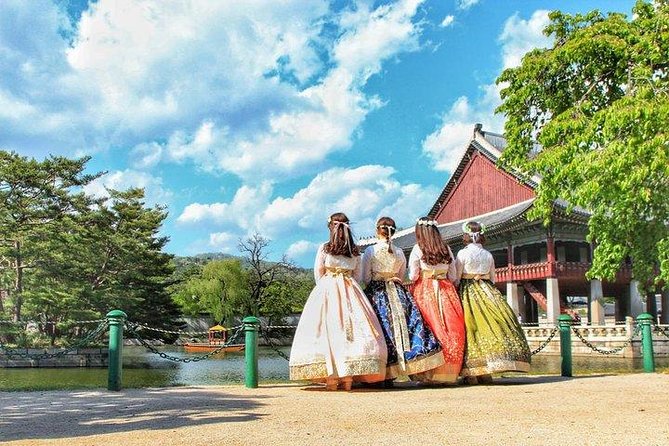
Reviewed · GYEONGJU HERITAGE TOURS
Small Group 7D Korea package Tour with Seoul Gyeongju Busan Jeju
Korea in one week takes careful planning. This seven-day small-group tour links Seoul, Jeju, Busan, Gyeongju, and the DMZ without compulsory shopping stops, a major plus for a short visit. I especially like the included domestic flight, KTX ride, cooking class, and Gwangjang Market food tour. You get both famous sights and ordinary Korean food culture.
The main tradeoff is pace. You cover a lot of ground, and some days pack six or seven stops. Different city guides handle different parts of the trip, so the quality and style of commentary may change. Still, the small maximum of 15 people keeps the experience more personal than a large coach tour.
In This Review
- Five things to know before booking
- What the $1,988 price really covers
- Day 1: Jeju’s volcanic coast from Woljeongri to Seongeup
- Day 2: Hallasan, waterfalls, black rock, and light art
- Day 3: Busan markets, hillside streets, and the sea
- Day 4: Silla-era Gyeongju and the KTX to Seoul
- Day 5: Korean cooking and Seoul’s young side
- Day 6: Seoul’s royal center, markets, and night views
- Day 7: The DMZ and a final Korean War viewpoint
- Guides, group size, and the tour’s real style
- Who should book this Korea tour?
- FAQ
- How long is the tour?
- Which destinations are included?
- Is transportation included?
- Are meals included?
- Do I need my passport for the DMZ?
- Is the Nanta show included?
- My verdict
Five things to know before booking
- Jeju comes first: Your trip begins with an airport pickup, a transfer to Gimpo Airport, and a flight to Jeju.
- No forced shopping: The program is built around sightseeing, food, culture, and transport rather than sales stops.
- Transport is a major value: The price includes the domestic flight, KTX bullet train, air-conditioned vehicle, and entrance fees.
- The schedule is full: Expect early starts, walking, stairs, short visits, and several long sightseeing days.
- The guide team changes: Guides named in the feedback include Jung, Jiyoung, Sang, Harry, Jones, and Clover, with different guides covering different sections.
- The DMZ needs your passport: You need identification for the checkpoint into the civilian control zone.
What the $1,988 price really covers
At $1,988 per person, this is not a shoestring tour, but it can be good value if you want to see several parts of South Korea in seven days. The package includes six nights in 3 to 4-star hotels, an English-speaking guide, entrance fees, an air-conditioned vehicle, the Jeju flight, and the KTX train from Gyeongju to Seoul.
Meals are also part of the calculation. The listed inclusions provide seven lunches and four breakfasts. The description also refers to some dinner arrangements, but the detailed inclusions do not promise a set number of dinners, so you should budget for extra meals and personal spending.
I like the way the transport is bundled. Moving from Seoul to Jeju, then through Busan and Gyeongju, could become a tangle of flights, trains, taxis, and hotel transfers if arranged alone. Here, the key links are handled for you. That matters most on a short trip, when losing half a day to a missed connection hurts.
The price also includes several admissions that add up: Seongsan Ilchulbong, Manjanggul Cave, Arte Museum Jeju, the Busan Blue Line Park, Gyeongju’s major sites, the Seoul palaces, N Seoul Tower, and the DMZ attractions. You still pay for personal purchases, optional entertainment, and anything outside the included meals.
More Jeju trips:
- Jeju: Eastern Jeju UNESCO Spots Day Tour
★ 4.9 · 1,148 reviews - Jeju: Western and Southern Sightseeing Day Tour
★ 4.8 · 972 reviews - East Jeju Essentials – Seongsan Ilchulbong (UNESCO) & Haenyeo
★ 5.0 · 939 reviews
Day 1: Jeju’s volcanic coast from Woljeongri to Seongeup
The first day starts with morning arrival at Incheon International Airport. A driver picks you up and takes you to Gimpo Airport, where you fly to Jeju. That airport transfer and domestic flight make the opening day efficient, but it is also a long arrival day. You will want to arrive rested enough for sightseeing soon after landing.
Jeju’s east coast provides a strong introduction. At Woljeongri Beach, you get about an hour around the shore and cafe street. The stop combines sea views with one of Jeju’s popular cafe areas, giving you a little urban leisure before the more geological sights.
At Gwangchigi Beach, the dark volcanic sand reflects Jeju’s basalt origins. This is a useful contrast with a standard sandy beach, and the hour here gives you time to look closely at the shoreline rather than simply photograph it from the vehicle.
Next comes Seongsan Ilchulbong, also called Sunrise Peak. This tuff cone rose from underwater volcanic eruptions about 5,000 years ago. The schedule allows roughly an hour, so you can walk toward the crater and enjoy the coastal views, but this is not a leisurely full-day hike.
Seasonal flowers can change the feel of the day. The Seongsan canola fields are listed from April through September, while the Noksan-Ro area is associated with cherry blossoms in late March and early April. Flower conditions depend on timing, so do not book this trip solely for a particular bloom.
Manjanggul Cave offers another look at Jeju’s volcanic past. The visit lasts about 30 minutes, followed by Seongeup Folk Village, where you see traditional Jeju houses and local ways of life. Both are brief stops, but together they keep the day from becoming only a beach-and-photo circuit.
The drawback is the number of transitions. Six stops after an international arrival and domestic flight leave little room for lingering. If you prefer slow mornings and long cafe breaks, Day 1 may feel rushed. If you want a broad first look at Jeju, the coverage is impressive.
Day 2: Hallasan, waterfalls, black rock, and light art
Day 2 continues around Jeju, with seasonal cherry blossoms near Jeju National University’s Ara Campus. The King Cherry Tree is noted for unusually large blossoms, with the usual viewing window around April 7 to 10. Again, timing matters, and the flowers are not guaranteed outside that period.
The itinerary also includes Jeju’s so-called mysterious road, where objects appear to roll uphill. This is an optical illusion, not a violation of gravity, but it makes a quick, amusing roadside stop.
You then spend about two hours around Hallasan National Park. Hallasan rises to 1,950 meters, making it South Korea’s highest mountain. It is a dormant basalt volcano with major geological value. The schedule does not present this as a full summit hike, so think of it as a scenic and ecological visit rather than a serious mountain expedition.
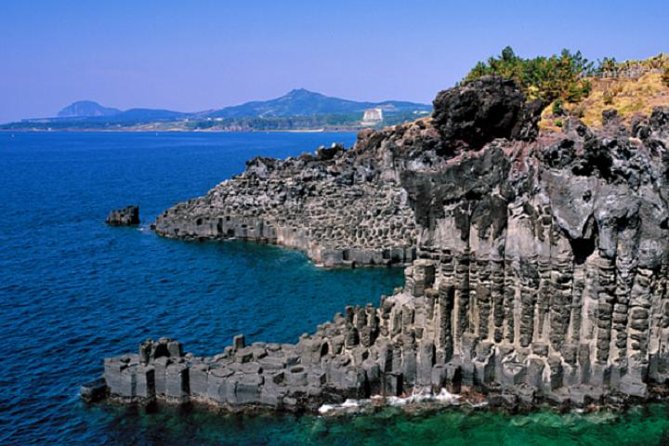
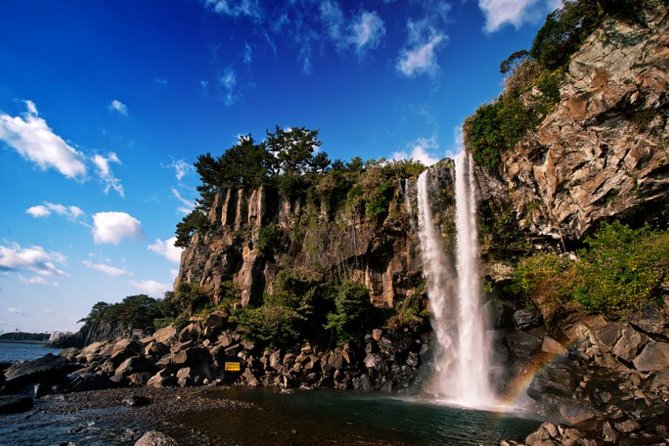
Other Jeju stops include a black-rock shoreline with striking cube and hexagon formations, Cheonjiyeon Falls, and Jeongbang Waterfall, which drops directly into the ocean. Cheonjiyeon comes with a local legend about seven heavenly fairies bathing in its waters. Jeongbang has a different appeal, combining the waterfall with the unusual sight of freshwater meeting the sea.
The final major visit is Arte Museum Jeju, an hour of light and video installations. This gives the day a modern indoor finish after the parks, coast, and waterfalls. It is also a practical change of pace if rain or strong sun makes outdoor sightseeing tiring.
Day 2 is packed, but the variety works. You move from flowers to an optical illusion, mountain scenery, volcanic rock, waterfalls, and digital art. You will not spend long at each place, yet the selection shows why Jeju works well in a fast national tour.
Day 3: Busan markets, hillside streets, and the sea
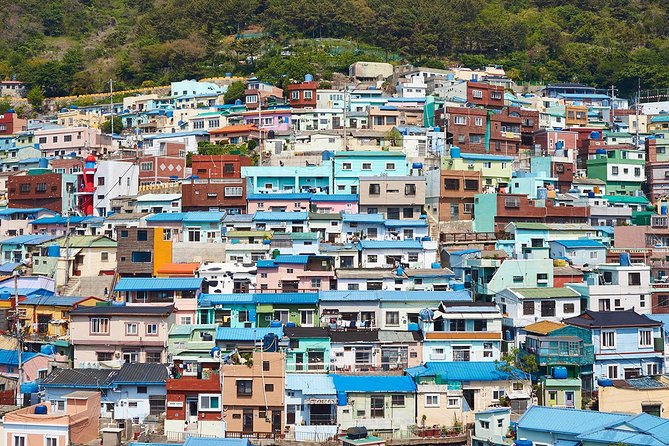
Busan brings a very different mood. The day begins on Haeundae Dalmaji-gil Road, a short stop known for cherry blossoms, pine trees, and views toward Haeundae Beach. In spring, this is one of the prettier road sections on the schedule, though 20 minutes is enough mainly for photos and a quick walk.
At Gamcheon Culture Village, you spend about an hour among houses built in stair-step rows on a coastal hillside. The settlement began with war refugees after the Korean War and later received city improvements that turned it into a major cultural stop. Expect slopes, stairs, and narrow passages. Good shoes matter here.
Jagalchi Market introduces Busan through seafood. The market is known for fresh fish and seafood vendors, many of them older women who have worked in the trade for years. You have time to look around and possibly eat, though meals beyond the listed inclusions remain your responsibility.
Nearby, BIFF Square adds movie history and street food. Gukje Market grew from stalls established by refugees after the Korean War and now sells new and used goods. These markets are more than shopping stops: they show how Busan rebuilt itself through trade, food, and small family businesses.
The afternoon moves to Haedong Yonggungsa, a seaside Buddhist temple often described as one of Korea’s most beautiful. Its coastal setting makes it different from the mountain temples visited in Gyeongju. The final stop, Haeundae Blue Line Park, includes a modern rail experience along the shore and offers a fresh view of Busan’s coast.
This is one of the tour’s most appealing days, but it asks you to keep moving. Gamcheon, the markets, the temple, and Blue Line Park each deserve more time than a quick visit can provide. The value comes from seeing the city’s main contrasts in one day, not from exploring any one neighborhood at length.
More Busan trips:
- 5-Day Korea Golden route by K-shuttle Tour from Seoul Including Busan, Yeosu
★ 4.5 · 37 reviews - 3-Days 2-Nights Gyeongju UNESCO Sites & Busan City [Private Tour from Seoul]
★ 4.5 · 11 reviews - 7 days Flexible Tour for Major Cities(Seoul,Busan,Gyeongju etc)
★ 5.0 · 5 reviews - Jinhae Cherry Blossom + Busan Sunrise from Seoul
★ 4.5 · 5 reviews
Day 4: Silla-era Gyeongju and the KTX to Seoul
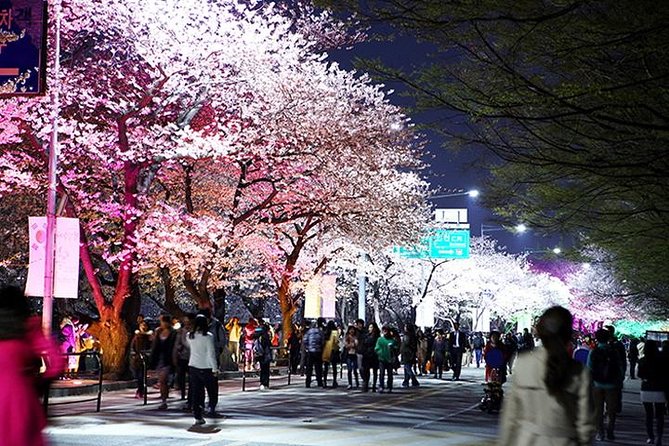
Gyeongju is the cultural heart of the itinerary. After about an hour of travel from Busan, you visit Bulguksa Temple, a UNESCO World Heritage site connected with the Silla capital. Its stone stairs, temple buildings, and Buddhist art provide a strong historical counterpoint to Busan’s markets and modern rail line.
At Seokguram, a stone grotto on Tohamsan Mountain, the focus shifts to a carefully preserved Buddhist sculpture site more than 1,200 years old. The visit is short, but the combination of Bulguksa and Seokguram explains why Gyeongju deserves a full day rather than a quick stop from Seoul.
Bomunho Lake Tourism Complex is especially attractive in April, when cherry blossoms line the walkway. At Daereungwon Tomb Complex, enormous rounded burial mounds rise from open grass. You can enter Cheonmachong Tomb, giving you a closer look at Silla burial practices than an outdoor walk alone would provide.
The day continues at Gyeongju Gyochon Traditional Village, known for the houses of noble families, then Donggung Palace and Wolji Pond. The pond is particularly atmospheric after dark, when the traditional pavilions reflect in the water. The evening visit is a smart choice because it adds a different mood to a day already full of temples and tombs.
You then board the KTX at Gyeongju Station for the roughly two-hour trip to Seoul. The train is fast and comfortable, but pay attention to the handoff. One piece of practical advice from the feedback is worth taking seriously: ask for help finding the correct platform and train if you are not comfortable navigating a Korean station alone. The tour is guided, but the train segment can feel more independent.
Day 5: Korean cooking and Seoul’s young side
A three-hour cooking class at Omi Cooking Research Center is one of the tour’s best local activities. You prepare three Korean dishes, generally bibimbap, a traditional pancake, and soup. The menu can change by season, but the class gives you more than a restaurant meal: you learn how familiar Korean dishes are put together.
The class also breaks up the sightseeing rhythm. After several days of vehicles and short outdoor stops, sitting down to cook gives you time to participate rather than simply look.
Later, Hongdae offers youthful Seoul, with shopping, food, and street performances. One hour gives you a taste, though not enough time to cover the whole district. I would use this stop for a snack, a quick walk, and a look at the street energy rather than trying to shop seriously.
The Nanta show at Myeongdong Theater is optional. It is a nonverbal performance, which makes it easy to follow even if you do not speak Korean. Listed ticket prices are $35 for S seats, $45 for P seats, and $55 for V seats. Since the tickets are not included, decide based on your budget and energy after a full day.
Day 6: Seoul’s royal center, markets, and night views
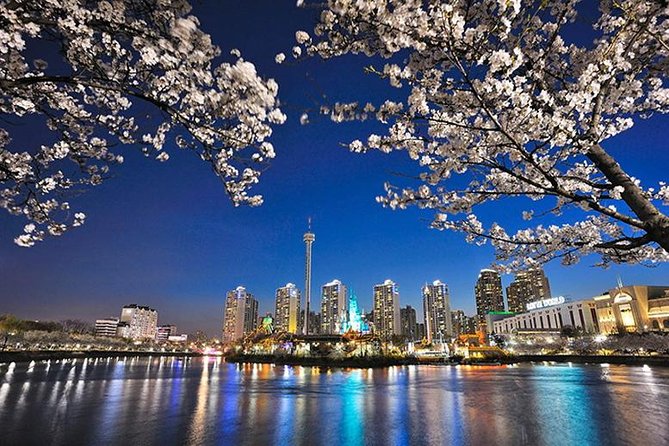
Day 6 covers many of Seoul’s best-known sights. Yeouido Park is associated with the spring cherry blossom festival, so April can bring a strong seasonal bonus. Outside blossom season, it remains a useful green pause beside the Han River.
At Gyeongbokgung Palace, you visit the largest and first palace built by the Joseon Dynasty in 1395. The palace sits beside Gwanghwamun Square and gives you a clear sense of Seoul’s royal center. One hour is enough for a guided overview, but not for every corner.
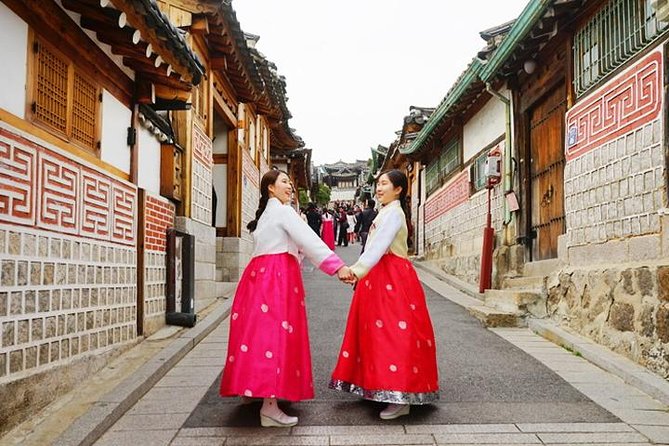
Jogyesa Temple provides a quieter Buddhist setting in the middle of the city. You then walk through Bukchon Hanok Village, a district of traditional houses packed along narrow lanes. Because it is a lived-in neighborhood, follow your guide’s instructions and keep voices low near homes.
The Gwangjang Market food tour is a highlight. The market was Korea’s first permanent market and is now famous for stalls serving Korean specialties. This is one of the places where the tour shifts from monuments to everyday eating. Come hungry, and keep some personal cash available even though the food experience is included.
The evening brings N Seoul Tower, with a 360-degree view from roughly 480 meters above sea level when the mountain and tower heights are combined. The final stops, Myeongdong Shopping Street and Insadong, let you choose between cosmetics and brand shopping in Myeongdong or tea houses, antiques, crafts, sweets, and traditional restaurants in Insadong.
This is the fullest Seoul day. It is useful for first-time visitors, but it is not relaxed. If you want time for museums or independent neighborhoods, you may need extra days after the tour ends.
Day 7: The DMZ and a final Korean War viewpoint
The final day heads north to Imjingak Pyeonghoa-Nuri Park, where you obtain tickets for the DMZ shuttle bus. Bring your passport. There is an identity check before entering the civilian control zone, and you should not treat this like an ordinary sightseeing district.
The Third Tunnel was dug by North Korea after the Korean War and is one of the most tangible parts of the DMZ visit. You can enter the tunnel itself, though the walk may feel confined and physically demanding for some people.
At Dora Observatory, you may see North Korea across the border with the naked eye. The visit is brief, but the setting gives the military division of the peninsula a clear physical meaning. Tongilchonan-gil is the final DMZ stop, with souvenirs and local products in a small market-like area.
The day closes at Gamaksan Chulleong Bridge, a suspension bridge reached after about a 10-minute hike. The area was a Korean War battlefield and now offers a short nature stop. It is a fitting final contrast: the tour ends with both a serious historical site and an outdoor view.
The program ends after Day 7. You can leave directly or stay in Seoul for extra free time, but your onward arrangements are not part of the stated package.
Guides, group size, and the tour’s real style
The maximum group size is 15, which is small enough for questions and easier vehicle movement. The experience is not a single-guide journey from start to finish. Different guides handle different cities, and names connected with the guiding team include Jung, Jiyoung, Sang, Harry, Jones, and Clover.
Harry is described as the lead organizer in one account, while Jung received praise for combining historical facts with current Korean politics, K-dramas, and K-pop. Sang is noted for high energy and extra effort, and the team is repeatedly described as friendly and accommodating. Those details suggest that guide personality is one of the tour’s strongest assets, though your exact guide lineup can vary.
The format is flexible and described as a private-style tour, despite the small-group setup. It is wise to keep 12 hours available for the guide’s condition and daily timing, since the schedule can shift. The tour suits people who prefer help with transport and context over complete independence.
Who should book this Korea tour?
Book it if you want a first Korea overview and have only one week. The route covers the country’s major highlights, includes the most awkward transport links, avoids compulsory shopping, and adds two worthwhile hands-on experiences: the cooking class and market food tour.
It is also a good match if you enjoy variety. In seven days, you see volcanic caves, beaches, royal palaces, Buddhist temples, seafood markets, modern art, a mountain observatory, and the DMZ.
Think twice if you want slow travel. The itinerary is demanding, some visits last only 20 to 40 minutes, and you will have limited unstructured time. The non-refundable booking terms also make this a poor fit if your dates are uncertain.
FAQ
How long is the tour?
The tour lasts approximately seven days and includes six nights of accommodation.
Which destinations are included?
The route covers Jeju, Busan, Gyeongju, Seoul, and the DMZ.
Is transportation included?
Yes. The package includes a domestic flight, the KTX bullet train, an air-conditioned tour vehicle, and vehicle costs.
Are meals included?
Seven lunches and four breakfasts are listed as included. Personal expenses and meals outside the stated inclusions are not covered.
Do I need my passport for the DMZ?
Yes. You need your passport for the identity check when entering the civilian control zone.
Is the Nanta show included?
No. Nanta is optional. Listed ticket prices are $35 for S seats, $45 for P seats, and $55 for V seats.
My verdict
I would recommend this tour to a first-time visitor who values efficient connections, strong coverage, and friendly local guides more than free time. The small group, no-compulsory-shopping policy, included transport, cooking class, and Gwangjang Market visit make the $1,988 price easier to justify.
Go in knowing that this is Korea at a brisk pace. Wear comfortable shoes, keep your passport ready for the DMZ, budget for personal meals and purchases, and ask for help at the KTX station if needed. For a short introduction to South Korea, it gives you a lot of country in one carefully packed week.
More Gyeongju Trips
- Gyeongju UNESCO Sites Tour by KTX train; The Museum Without walls
★ 4.5 · 11 reviews - 7 Day Essential Korea Tour(Seoul, Nami, DMZ, Andong, Gyeongju, Busan_Meal Incl.)
★ 5.0 · 3 reviews - Busan: Gyeongju Guided Day Trip to Three Kingdoms Capital
★ 4.8 · 1,925 reviews - From Busan: Gyeongju UNESCO World Heritage Guided Day Tour
★ 4.8 · 1,250 reviews
Just added around Seoul
- Seoraksan National Park & Nami Island★ 4.5 · 3 reviews
- Strawberry Picking, Winter Sled with Eobi Ice Valley from Seoul★ 4.5 · 3 reviews
- Seoul Full Day small group Tour★ 5.0 · 3 reviews
- Seoul Korean BBQ Dinner Experience with Secret Food Tours★ 5.0 · 3 reviews
- Rice Wine Tasting with Sommelier – Finest Makgeolli (& Soju)★ 5.0 · 3 reviews
- Majang Meat Market Experience: Private Tour with Han-woo Beef BBQ★ 5.0 · 3 reviews
- Seongsu-dong Walking Tour: K-Pop, Culture, Cheer, Friends & Relax★ 4.5 · 3 reviews
- Seoul: Alpaca World and Nami Island (with Garden / Railbike)★ 5.0 · 3 reviews
Gyeongju Heritage Tours, compared.

Gyeongju Guided Day Trip to Three Kingdoms Capital
Read our review →
Gyeongju UNESCO World Heritage Guided Day Tour
Read our review →
Gyeongju UNESCO World Heritage Guided Day Tour from Busan
Read our review →
Old Korea Thousand History Tour of Gyeongju from Busan
Read our review →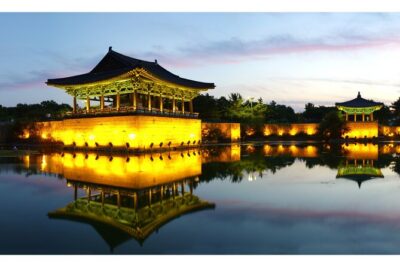
Gyeongju UNESCO sites Private tour with licensed tour guide
Read our review →
Private Gyeongju Tour – Explore Gyeongju UNESCO Sites
Read our review →
Gyeongju UNESCO Legacy Tour with National Museum
Read our review →
UNESCO Heritage Tour Including Bulguksa Temple
Read our review →Browse the lists this tour appears in